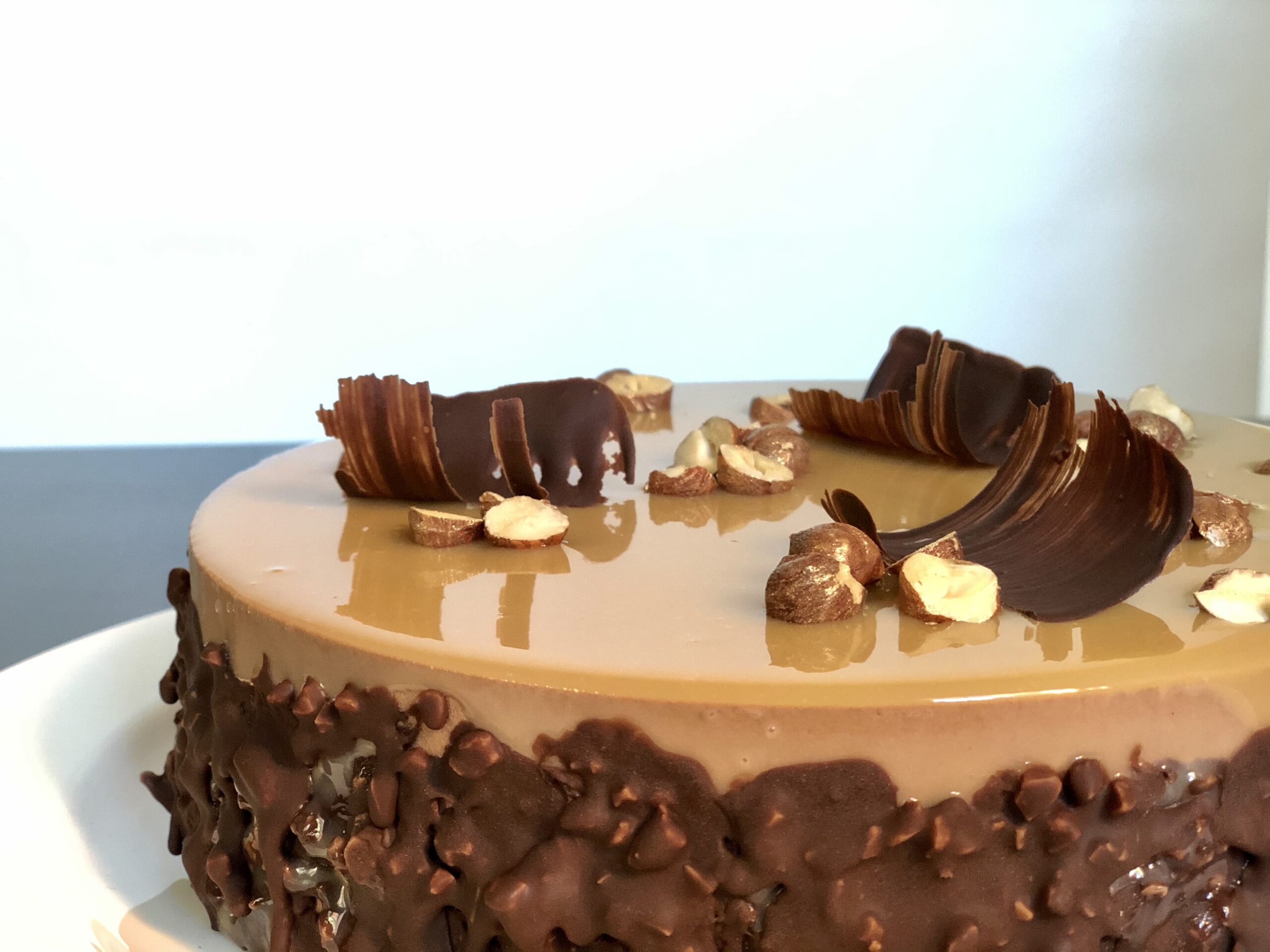
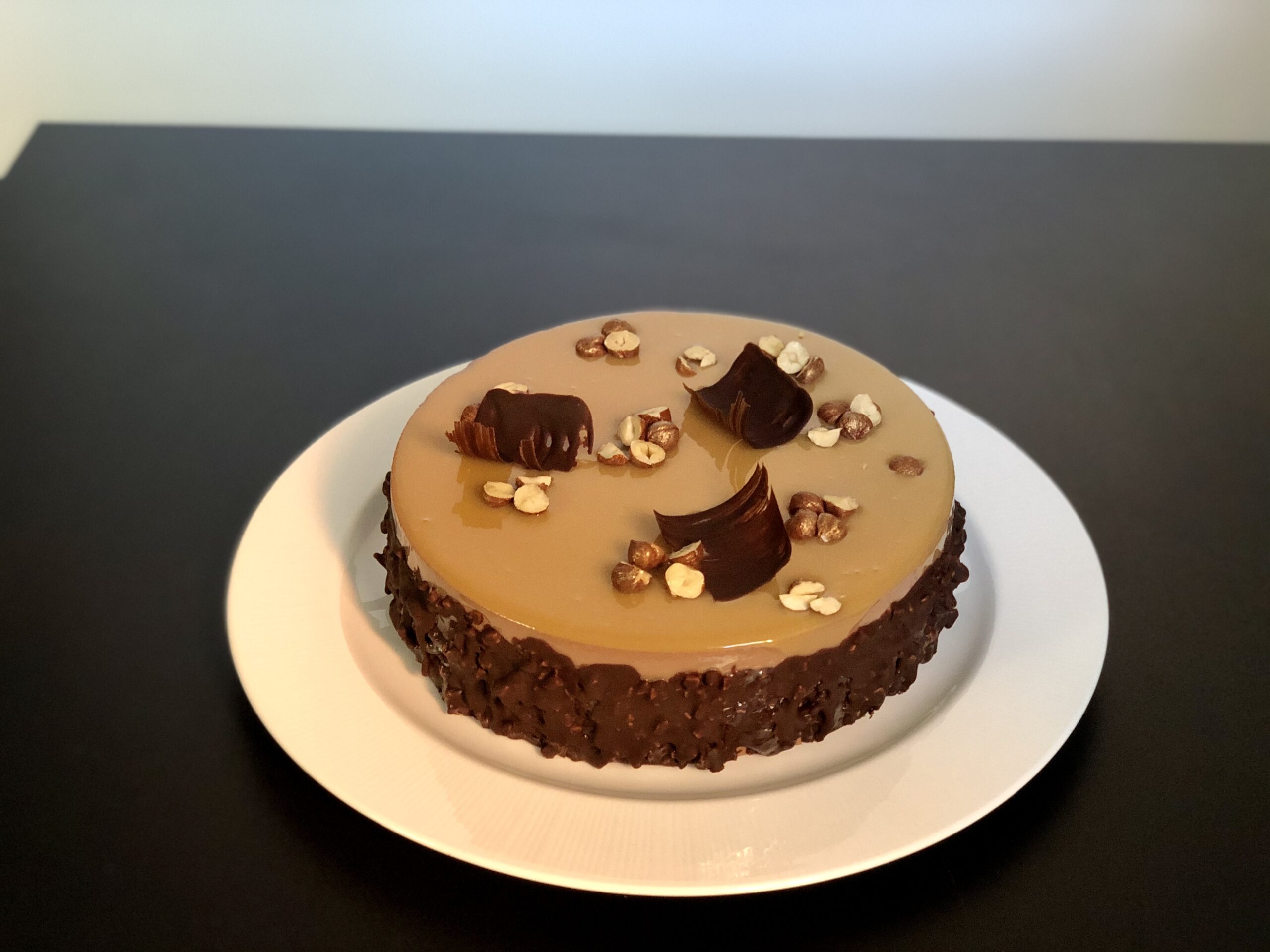
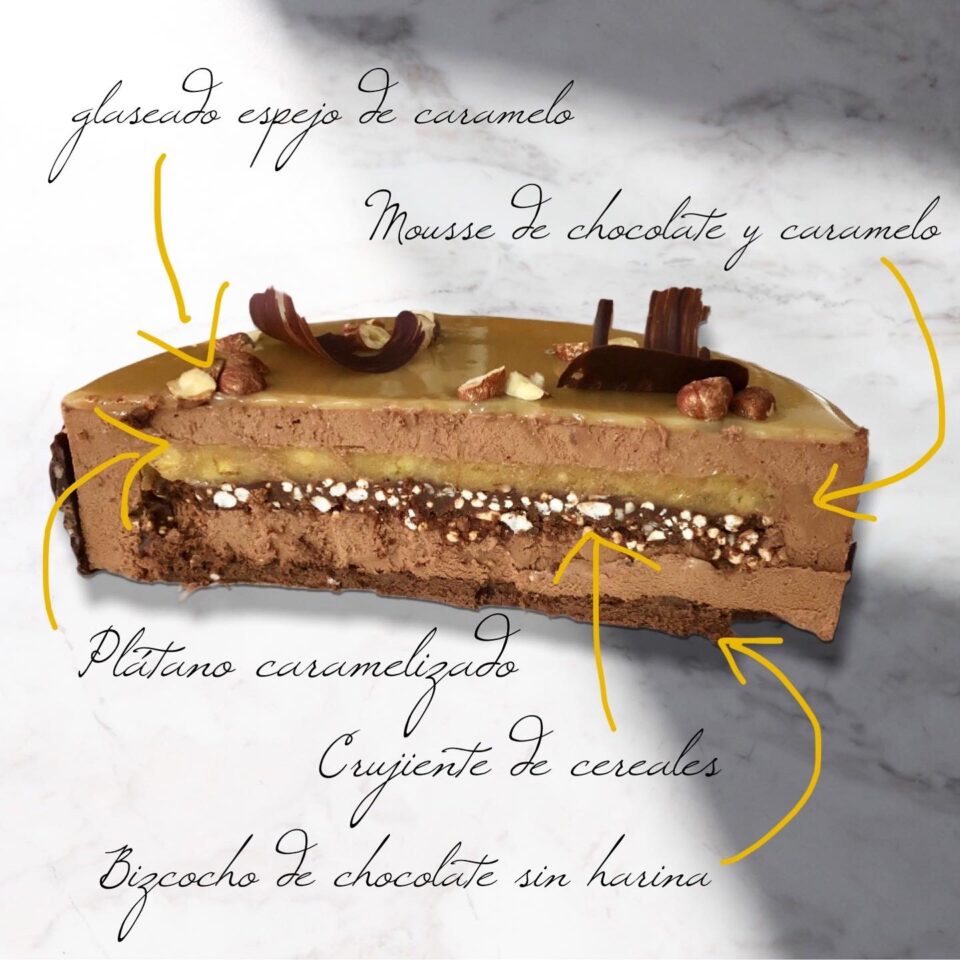
Chocolate and caramel cake with banana and crunchy cereal layer

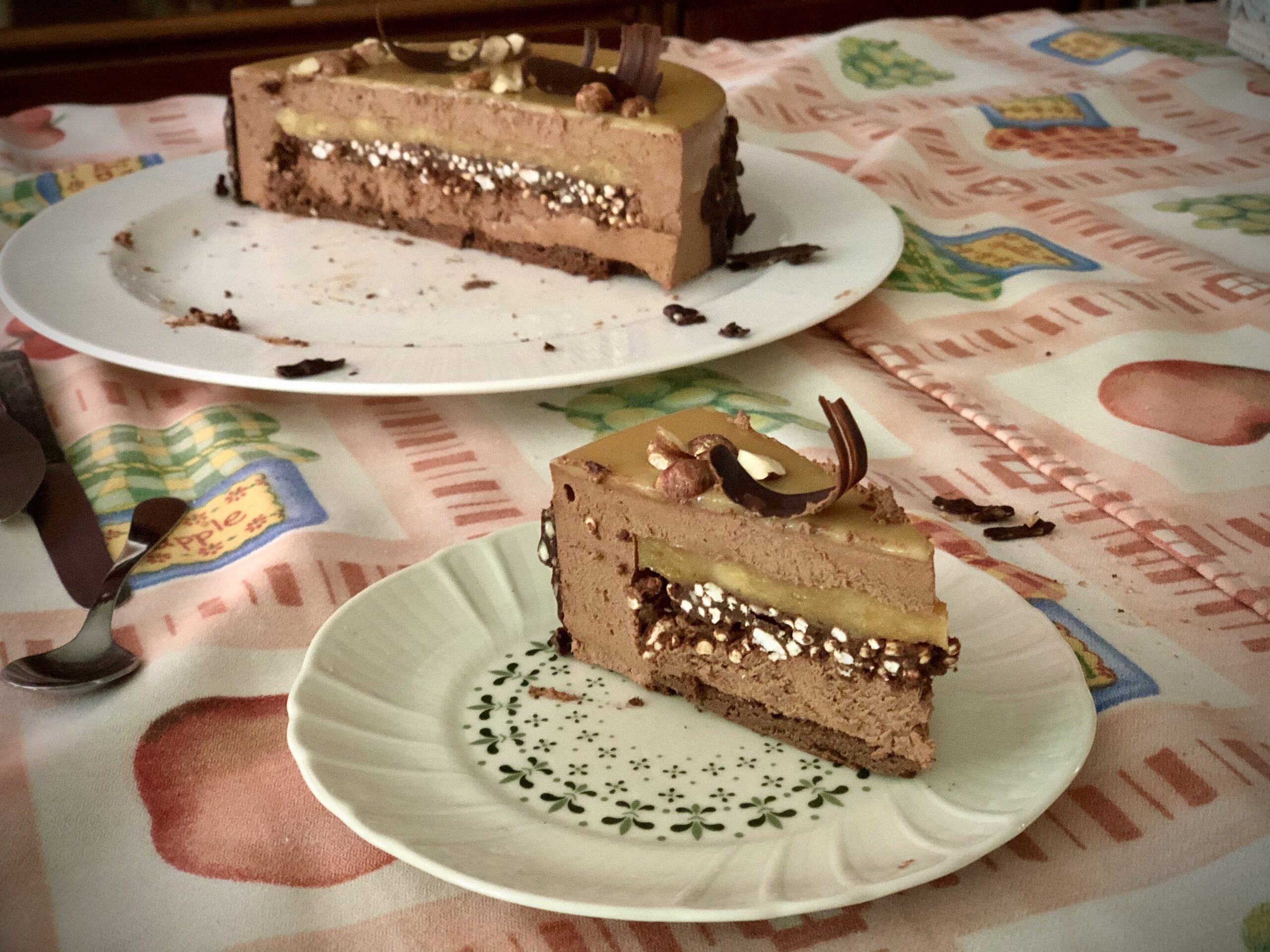
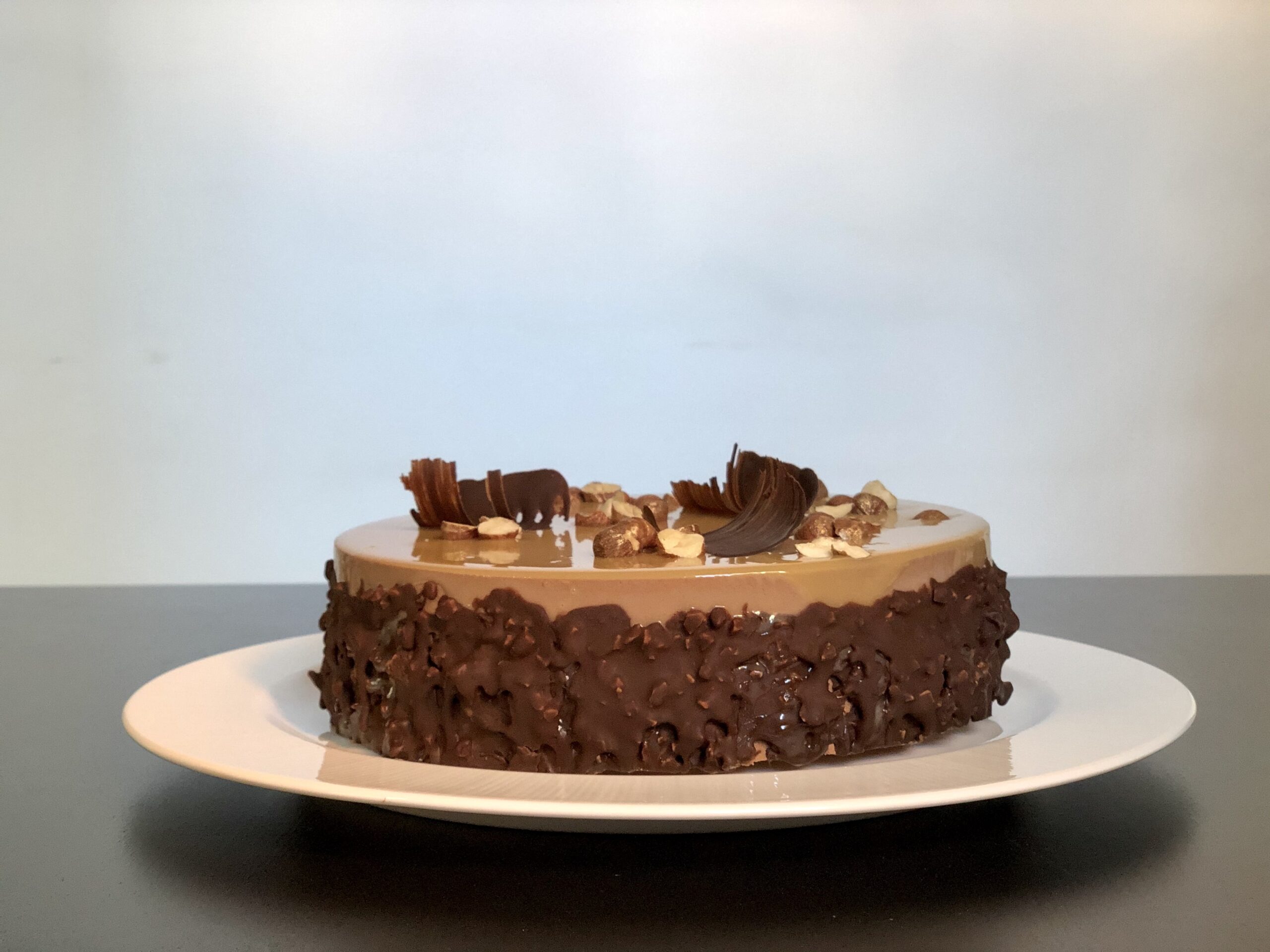
This time I wanted to make a chocolate cake that didn't have a super intense pure-chocolate flavor, since some of my taste-testers aren't huge fans of that level of intensity. The banana filling won me over as a way to balance out all that sweetness, and the crunchy layer adds a bit of joy to creamy desserts.

The recipe is from Ettore Cioccia, although I made several changes to the filling and decoration because I wanted to use up ingredients I had at home and try out some new things. So here's my version of this delicious cake — I hope you like it. It's not a complicated cake, but it does have several components and requires patience and planning to give yourself enough time, considering all the chilling/freezing times involved.
Pics and Cakes

Ingredients

Crunchy cereal layer

  • 60 g (2.1 oz) almond butter
  • 35 g (1.2 oz) chocolate
  • 20 g (0.7 oz) raw chopped hazelnuts
  • 15 g (0.5 oz) puffed rice
  • 15 g (0.5 oz) puffed quinoa

Caramelized banana

  • 30 g (2 tbsp) sugar
  • 15 g (1 tbsp) butter
  • 3 bananas (210 g / 7.4 oz)
  • Lemon juice
  • 2 g gelatin (1 sheet)

Flourless chocolate sponge

  • 60 g (2.1 oz) 65% dark chocolate
  • 20 g (1.5 tbsp) unsalted butter
  • 2 egg whites at room temperature
  • 2 egg yolks
  • 20 g (1.5 tbsp) sugar

Chocolate and caramel mousse

  • 200 g (7 oz) 65% chocolate
  • 6 g gelatin (3 sheets)
  • 60 g (1/4 cup) sugar
  • 100 ml (1/2 cup) heavy whipping cream
  • 4 egg yolks, beaten
  • 400 g (14 oz) heavy cream whipped to soft peaks

Ferrero-style coating

  • 215 g (7.6 oz) 65% chocolate
  • 40 g (3 tbsp) sunflower oil
  • 45 g (1.6 oz) chopped almonds (almond brittle)

Caramel mirror glaze

  • 300 g (1.5 cups) sugar
  • 300 g (1 cup) glucose syrup, slightly warmed in the microwave
  • 375 ml (1.5 cups) water
  • 200 g (7 oz) sweetened condensed milk
  • 300 g (10.6 oz) white couverture chocolate, finely chopped
  • 18 g gelatin, hydrated beforehand and then dissolved in 108 ml (about 1/2 cup) of hot water

Method

  1. We start by making the crunchy cereal layer. Melt the chocolate in the microwave in short bursts to keep it from burning. Next, add the almond butter and mix well. Finally, add the cereals and hazelnuts and mix again until everything comes together.
  2. Line the bottom of a 17 cm (6.7 in) springform ring or pan with plastic wrap and a strip of acetate around the edge. Pour in the chocolate mixture and smooth out the surface with a spoon. Pop it into the freezer.
  3. For the caramelized banana, hydrate the gelatin in a bowl of cold water.
  4. Cut the bananas into small dice and add a splash of lemon juice so they don't oxidize.
  5. Put the sugar in a saucepan and let it melt until it forms an amber-colored caramel. Add the butter, and once it's incorporated, add the banana. Cook for a few minutes over low heat, stirring frequently (the mixture is likely to get more liquid as the fruit releases its juice).
  6. Drain the gelatin well and stir it into the saucepan after turning off the heat. Stir well so it dissolves completely.
  7. Take the crunchy layer out of the freezer and pour the caramelized banana on top, forming another even layer. Put it back in the freezer.
  8. To make the chocolate sponge, preheat the oven to 180°C (355°F).
  9. Melt the chocolate and butter in short bursts in the microwave.
  10. In another bowl, whip the egg whites to stiff peaks with a pinch of salt and the sugar. Once they're firm, fold in the beaten yolks gently.
  11. Next, add the melted chocolate, also folding gently so it doesn't deflate, until you have a smooth batter.
  12. Spread it onto a parchment-lined baking sheet (it's not a lot of batter and it's not very runny) until it's about 1 cm (0.4 in) thick. The important thing is that you'll be able to cut a 17 cm (6.7 in) circle out of it later.
  13. Bake for 8 minutes.
  14. To make the chocolate and caramel mousse, hydrate the gelatin sheets in very cold water.
  15. Melt the chocolate in the microwave in short bursts and set aside.
  16. In a saucepan, melt the sugar and let it cook until you get a light caramel. Add 100 ml (1/2 cup) of cream (warmed in the microwave so there isn't a big temperature difference). Pour it in a little at a time, stirring constantly to keep crystals from forming, and very carefully so it doesn't splash you.
  17. Pour the mixture over the beaten egg yolks while stirring constantly, then return it to the heat until it reaches 82–84°C (180–183°F).
  18. Take it off the heat and add the well-drained gelatin, stirring until it dissolves.
  19. Next, blend with an immersion blender until smooth, and pour this hot cream over the melted chocolate. Mix well and let cool to 40–45°C (104–113°F).
  20. Finally, fold in a third of the soft-peak whipped cream and mix. Add the rest and fold gently again.
  21. For the assembly, take a 20 cm (8 in) springform pan (or ring) and line the edge with a strip of acetate and the bottom with plastic wrap.
  22. Now we're going to layer everything. First, spread a generous layer of chocolate and caramel mousse in the bottom and use a spatula to coat the sides too. Then unmold the banana and hazelnut crunch insert and place it on top of the mousse with the crunchy side facing up. Fill with more mousse, and finally lay down the chocolate sponge disc. Put the cake in the freezer for at least 3–4 hours (I leave it overnight and finish the decoration the next day).
  23. Now we're going to prepare the glazes. For the Ferrero-style coating, melt the chocolate in the microwave and then add the oil. Once it's well combined, add the chopped almonds. Set aside until it cools to 35°C (95°F).
  24. To make the caramel mirror glaze, hydrate the gelatin in a bowl of cold water. Heat the water, drain the gelatin, and dissolve it in this hot water. Set aside.
  25. In a saucepan, make a dry caramel using just the sugar — no water. When it turns a dark golden color, turn off the heat and pull the pan off the burner. Immediately and very carefully, slowly pour in the 375 ml (1.5 cups) of water while whisking. (Be very careful — it splatters and burns badly.)
  26. Then add the glucose, stir well until it dissolves, and next add the condensed milk and white chocolate, whisking until the chocolate dissolves and is fully incorporated.
  27. Finally, add the dissolved gelatin and mix until combined. Let it rest until the caramel cools to 25–30°C (77–86°F).
  28. All that's left is the final assembly. Take the frozen cake out of the freezer and remove the pan, the acetate strip, and the plastic wrap. Set the cake on top of a smaller mold or bowl so it's elevated and you can glaze it well. It's a good idea to put a plate or tray underneath to catch the drippings of glaze so you can reuse them.
  29. First we're going to glaze the sides with the Ferrero coating. The easiest way is to put the coating in a pitcher and pour it over the sides. Since the cake is frozen, the chocolate will set almost instantly. If you have any gaps, you can patch them up with the help of a spoon.
  30. Finally, pour the mirror glaze over the top of the cake. You want to use just the right amount so it only covers the top and doesn't drip down the sides. You can finish decorating it with broken hazelnuts and chocolate.
  31. Carefully transfer it to a flat plate and store in the fridge. Before serving, you'll need to give it 2 or 3 hours to defrost slowly.
Pics and Cakes
Pics and Cakes
Pics and Cakes

PiC tips

  • The amounts I give for the mirror glaze are enough to cover the entire cake (top and sides). In that case, you wouldn't need the Ferrero-style coating, and it would also look beautiful. Any leftover glaze (that hasn't been contaminated with other components of the cake) can be stored in the fridge for a few days, or longer in the freezer, and reheated whenever you want to glaze another dessert. In fact, that's what I did. This glaze had been frozen — it was leftover from a previous cake. You can also choose to halve the quantities.
  • I used almond butter, but you can use any other nut butter or even praline like Ettore does in his original recipe.
Pics and Cakes
14 de octubre de 2020 · 7 min · Palstelera

Tarta de chocolate y caramelo con plátano y crujiente de cereales

En esta ocasión quería hacer una tarta de chocolate que no tuviera un sabor muy intenso a chocolate puro ya que algunos de los catadores no son muy fan de esos niveles de intensidad. El relleno de plátano me convenció como matiz para compensar tanto dulzor y la capa crujiente le da un poco de alegría a los postres cremosos.

La receta es de Ettore Cioccia aunque introduje varios cambios en el relleno y en la decoración porque quería aprovechar ingredientes que tenía en casa y experimentar cosas nuevas. Así que aquí os dejo mi versión de esta deliciosa tarta que espero que os guste. No es una tarta complicada pero sí tiene varias elaboraciones y requiere paciencia y planificación para hacerla con tiempo suficiente teniendo en cuenta los tiempos de enfriado/congelado necesarios.

Pics and Cakes

Ingredientes

Crujiente de cereales

  • 60 g mantequilla de almendra
  • 35 g chocolate
  • 20 g avellanas crudas troceadas
  • 15 g de arroz inflado
  • 15 g de quinoa inflada

Banana caramelizada

  • 30 g azúcar
  • 15 g mantequilla
  • 3 plátanos (210 g)
  • Zumo de limón
  • 2 g de gelatina (1 hoja)

Bizcocho de chocolate sin harina

  • 60 g chocolate negro 65%
  • 20 g mantequilla sin sal
  • 2 claras de huevo a temperatura ambiente
  • 2 yemas de huevo
  • 20 g azúcar

Mousse de chocolate y caramelo

  • 200 g chocolate 65%
  • 6 g gelatina (3 hojas)
  • 60 g azúcar
  • 100 ml nata para montar
  • 4 yemas de huevo batidas
  • 400 g nata montada en picos suaves

Cobertura tipo Ferrero

  • 215 g chocolate 65%
  • 40 g aceite de girasol
  • 45 g almendra granillo

Glaseado espejo de caramelo

  • 300 g azúcar
  • 300 g glucosa calentada ligeramente en el microondas
  • 375 ml agua
  • 200 g leche condensada
  • 300 g chocolate blanco de cobertura picado finamente
  • 18 g gelatina hidratada previamente y disuelta después en 108 ml de agua caliente

Elaboración

  1. Empezamos preparando el crujiente de cereales. Para ello, derretimos el chocolate en el microondas en intervalos de pocos segundos para evitar que se nos queme. A continuación, añadimos la mantequilla de almendra y mezclamos bien. Por último, incorporamos los cereales y las avellanas y volvemos a mezclar hasta que se integre.
  2. En un aro o molde desmoldable de 17 cm colocamos film transparente en la parte inferior y una tira de acetato en el borde. Vertemos nuestra mezcla de chocolate y alisamos la superficie con una cuchara. Llevamos al congelador.
  3. Para el plátano caramelizado, hidratamos la gelatina en un bol con agua fría.
  4. Cortamos los plátanos en dados pequeños y les añadimos un chorrito de zumo de limón para que no se oxide.
  5. Ponemos el azúcar en un cazo y dejamos que se derrita hasta formar un caramelo de color ámbar. Incorporamos la mantequilla y cuando esté integrada, añadimos el plátano. Cocinamos unos pocos minutos a fuego lento removiendo frecuentemente (es probable que la mezcla se vuelva más líquida con el jugo que suelte la fruta).
  6. Escurrimos bien la gelatina y la incorporamos al cazo ya con el fuego apagado. Removemos bien para que se disuelva por completo.
  7. Sacamos el crujiente del congelador y echamos el plátano caramelizado encima formando otra capa uniforme. Guardamos de nuevo en el congelador.
  8. Para preparar el bizcocho de chocolate, precalentamos el horno a 180ºC.
  9. Derretimos el chocolate y la mantequilla a intervalos cortos en el microondas.
  10. En otro bol montamos las claras a punto de nieve con una pizca de sal y el azúcar y cuando estén bien firmes añadimos las yemas batidas con movimientos envolventes.
  11. A continuación añadimos el chocolate derretido también con movimientos suaves y envolventes para que no se baje hasta obtener una masa homogénea.
  12. Extendemos sobre una bandeja con papel de horno (no es mucha cantidad ni es una masa muy líquida) hasta obtener un grosor de 1 cm aproximadamente. Lo importante es que luego podamos obtener un círculo de bizcocho de 17 cm.
  13. Horneamos 8 minutos.
  14. Para preparar la mousse de chocolate y caramelo, hidratamos las hojas de gelatina en agua muy fría.
  15. Derretimos el chocolate en el microondas en intervalos cortos y reservamos.
  16. En un cazo ponemos el azúcar y dejamos cocinar hasta obtener un caramelo claro. Le añadimos 100 ml de nata (templada en el microondas para que no haya mucha diferencia de temperatura). Hay que echarla poco a poco y removiendo constantemente para evitar que se formen cristales y con mucho cuidado para que no nos salpique.
  17. Vertemos la preparación sobre las yemas de huevo batidas sin dejar de remover y ponemos de nuevo al fuego hasta que llegue a los 82-84º C.
  18. Retiramos del fuego y añadimos la gelatina bien escurrida, removemos hasta que se disuelva.
  19. A continuación, batimos con la batidora eléctrica hasta obtener una textura homogénea y añadimos esta crema caliente sobre el chocolate derretido. Mezclamos bien y dejamos enfriar hasta los 40-45º C.
  20. Por último, incorporamos un tercio de la nata montada en picos suaves, y mezclamos. Añadimos el resto y mezclamos de nuevo delicadamente.
  21. Para el montaje, cogemos un molde desmoldable (o aro) de 20 cm y colocamos una tira de acetato en el borde y film en la base.
  22. Vamos a insertar todas las preparaciones anteriores. Primero ponemos una generosa capa de mousse de chocolate y caramelo en el fondo y con una espátula lo extendemos por las paredes también. Luego desmoldamos el plátano y el crujiente de avellana y lo colocamos sobre la mousse con el crujiente hacia arriba. Rellenamos con más mousse, y por último colocamos el disco de bizcocho al chocolate. Guardamos la tarta en el congelador mínimo unas 3-4 horas (yo la dejo toda la noche y al día siguiente termino la decoración).
  23. Ahora vamos a preparar los glaseados. Para la cobertura tipo Ferrero derretimos el chocolate en el microondas y añadimos luego el aceite. Cuando esté bien integrado añadimos la almendra en granillo. Reservamos hasta que esté a 35º C.
  24. Para hacer el glaseado espejo de caramelo hidratamos la gelatina en un bol con agua fría. Calentamos el agua, escurrimos la gelatina y la deshacemos en esta agua caliente. Reservamos.
  25. En un cazo hacemos un caramelo solo con el azúcar en seco, sin añadirle agua, cuando tome un color rubio oscuro, apagamos el fuego y apartamos el cazo. Inmediatamente con cuidado y poco a poco vamos añadiendo los 375 ml de agua, mientras vamos removiendo con unas varillas. (Mucho cuidado porque esto salta y quema mucho).
  26. Luego agregamos la glucosa , removemos bien hasta que se disuelva y, a continuación, incorporamos la leche condensada y el chocolate blanco, removiendo con las varillas hasta que el chocolate se disuelva y se integre completamente.
  27. Por último añadimos la gelatina disuelta y mezclamos hasta incorporar. Dejamos reposar hasta que la temperatura del caramelo descienda hasta los 25-30ºC.
  28. Ya solo nos queda el montaje final. Sacamos la tarta congelada del congelador y retiramos el molde y la lámina de acetato y el film. Colocamos la tarta sobre otro molde más pequeño o cuenco para que quede con altura y la podamos glasear bien. Es recomendable que debajo pongas un plato o bandeja para recuperar los restos de glaseado que caiga y lo puedas volver a usar.
  29. Primero vamos a glasear las paredes con la cobertura Ferrero. Para ello lo mejor es poner la cobertura en una jarra e ir echándolo sobre las paredes. Como la tarta está congelada, el chocolate se solidificará casi al instante. Si te quedan huecos sin cobertura puedes ir «parcheando» con ayuda de una cuchara.
  30. Por último, añadimos el glaseado espejo en la parte superior de la tarta. Hay que echar la cantidad exacta para que solo cubra la parte superior y no gotee por las paredes. Puedes terminar de decorarla con avellanas partidas y chocolate.
  31. Con cuidado la pasamos a un plato llano y la guardamos en la nevera. Antes de disfrutarla tendrán que pasar 2 o 3 horas para que se descongele tranquilamente.
Pics and Cakes
Pics and Cakes
Pics and Cakes

Consejos PiC

  • Las cantidades que pongo para el glaseado espejo dan para cubrir toda la tarta con glaseado espejo (parte superior y paredes). En este caso, no te haría falta la cobertura tipo Ferrero y quedaría preciosa también. El glaseado que te sobre (y que no esté sucio de otras elaboraciones de la tarta) lo puedes guardar en la nevera unos días o en el congelador más tiempo y volver a calentarlo cuando quieras glasear otro postre. De hecho, es lo que yo hice. Este glaseado había estado congelado y era lo que me sobró de otra tarta previa. También puedes optar por reducir las cantidades a la mitad.
  • Yo utilicé mantequilla de almendras pero puedes usar de cualquier otro fruto seco o incluso praliné como hace Ettore en su receta original.
Pics and Cakes
14 de octubre de 2020 · 7 min · Palstelera

Petit suisse de fresa

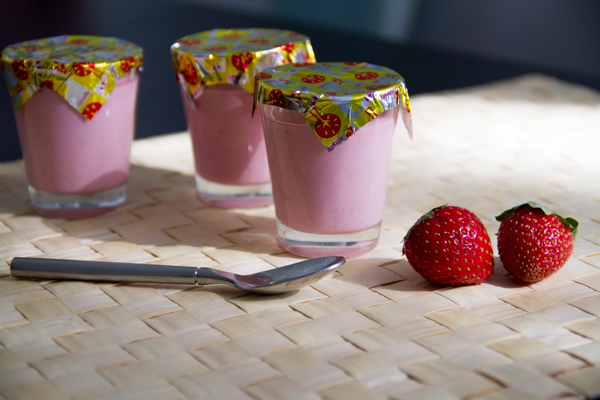
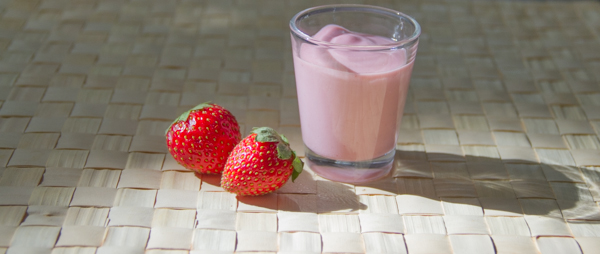
Para muchos es seguramente un recuerdo de infancia y apuesto que, de vez en cuando, tenéis la tentación de volver a comprarlos y comeros dos sin que vuestra madre os regañe. Pues bien, si os digo que los podéis hacer en casa y que el tamaño depende de vosotros, creo que ya estáis tardando en ir a comprar unos buenos fresones.

Pics and Cakes

¿Qué necesitamos?

  • 500 g de fresas
  • 250 g de queso crema (tipo Philadelphia)
  • 100 g de nata de montar
  • 150 g de azúcar
  • 2 cucharaditas de cuajada en polvo


 ¿Cómo lo hacemos?

  1. En primer lugar, lavamos las fresas y les quitamos el rabito. Las trituramos bien con la batidora hasta obtener un puré de fresas.
  2. En un vasito ponemos un poco del puré de fresas y disolvemos la cuajada. Reservamos.
  3. Ponemos el resto del puré de fresas en un cazo y lo calentamos hasta que hierva.
  4. Lo retiramos del fuego, añadimos la parte del puré donde habíamos disuelto la cuajada y lo removemos bien.
  5. Lo ponemos de nuevo al fuego, unos dos minutos sin dejar de remover. (CUIDADO en este paso ya que si ponéis muy fuerte el fuego  puede salpicaros el puré de fresas y quemaros. Os aseguro que el maldito es peor que el agua porque, al ser más denso, se te pega con ganas).
  6. Dejamos templar el puré un poquito y añadimos el resto de ingredientes (azúcar, queso y nata).
  7. Batimos todo bien con la batidora y vemos que ya habrá adquirido un bonito color de petit suisse.
  8. Solo nos queda verterlo en los vasitos que queramos servirlo y lo dejamos en la nevera toda la noche.

Pics and Cakes

Consejos:

– Nosotros utilizamos vasos de chupito, quedan muy bien y es una medida perfecta ya que tenemos que admitir que se trata de un postre consistente (ahora entiendo porque las madres no nos dejaban comer muchos…:-P). También podéis usar los vasos de cristal de yogures o cualquier vasito que tengáis.

– No puedo deciros a ciencia cierta cuánto tiempo nos pueden durar en la nevera pero con los ingredientes que lleva calculo que una semana aguantan sin problema.

 
4 de junio de 2015 · 2 min · Palstelera

Strawberry Petit Suisse

For many of you, this is probably a childhood memory, and I bet that every once in a while you get tempted to buy them again and eat two in a row without your mom scolding you. Well, if I tell you that you can make them at home and that the size is up to you, I think you should already be on your way out to buy some good ripe strawberries.

Pics and Cakes

What do we need?

  • 500 g (1.1 lb) strawberries
  • 250 g (9 oz / about 1 cup) cream cheese (Philadelphia type)
  • 100 g (about 1/2 cup) heavy whipping cream
  • 150 g (3/4 cup) sugar
  • 2 teaspoons powdered cuajada (rennet-based setting mix)


How do we make it?

  1. First, wash the strawberries and remove the stems. Blend them well with a hand blender until you get a strawberry purée.
  2. In a small glass, put a bit of the strawberry purée and dissolve the cuajada in it. Set aside.
  3. Put the rest of the strawberry purée in a saucepan and heat it until it boils.
  4. Remove from the heat, add the portion of purée with the dissolved cuajada, and stir well.
  5. Put it back on the heat for about two minutes, stirring constantly. (BE CAREFUL at this step because if the heat is too high the strawberry purée can splatter and burn you. Trust me, the stuff is worse than water — being denser, it really sticks to you.)
  6. Let the purée cool down a little and then add the rest of the ingredients (sugar, cheese, and cream).
  7. Blend everything well with the hand blender and you'll see it has already taken on a lovely petit suisse color.
  8. All that's left is to pour it into whatever little glasses you want to serve it in and leave it in the fridge overnight.

Pics and Cakes

Tips:

– We used shot glasses — they look really cute and it's the perfect portion size, since we have to admit this is a pretty rich dessert (now I understand why our moms wouldn't let us eat too many… :-P). You can also use the little glass yogurt jars or any small cup you have around.

– I can't tell you for sure how long they'll keep in the fridge, but with these ingredients I'd estimate they'll last a week without any problem.

4 de junio de 2015 · 2 min · Palstelera

Estonian Kringle

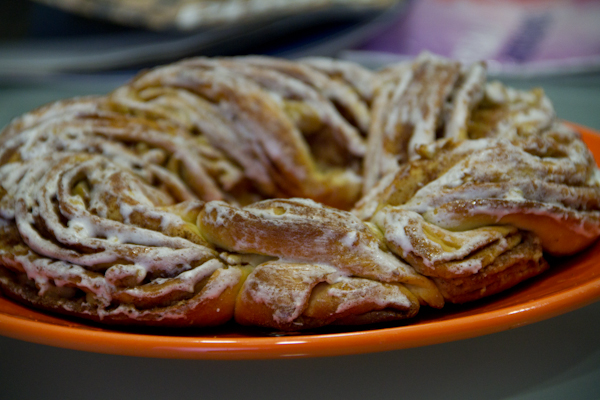
It’s not just that it seems like we haven’t published anything in ages — it’s actually true… almost three months without any blog action on PiC! The summer has been a bit hectic but here we are, back and loaded with new finger-licking recipes. Today I’m bringing you a recipe that could be considered the Nordic roscón de Reyes, and some say its shape is reminiscent of pretzels and the dough is brioche-style. In short, a sweet wonder we pulled from a Thermomix magazine but made without one to prove that any recipe is adaptable.

Pics and Cakes

What do we need?

For the dough:

  • 30 g (2 tbsp) sugar

  • The peel of 1/2 lemon (yellow part only)

  • 120 g (1/2 cup) milk

  • 30 g (2 tbsp) butter

  • 15 g fresh yeast

  • 1 egg yolk

  • 300 g (2.5 cups) bread flour

  • **1 pinch of salt

For the filling:

  • 50 g (3.5 tbsp) butter (room temperature)

  • 60 g (1/4 cup) sugar

  • 2 tablespoons cinnamon

  • 50 g (1/2 cup) chopped walnuts

For the glaze:

  • 20 g egg white

  • 50 g (1/2 cup) confectioners’ sugar

How do we make it?

  • If we have an electric coffee grinder or a food processor, we put the sugar with the lemon peel and grind it well until the lemon is incorporated into the sugar and we get a sort of paste. If we don’t have one, we can just grate the lemon peel and mix it with the sugar.

  • We heat the milk a little in the microwave and add it to the bowl with the sugar and lemon peel.

  • We add the butter and the yeast and stir until everything comes together nicely.

  • We add the egg yolk and mix well again.

  • Finally, we add the flour and the salt. We stir with a spoon or fork and then transfer the dough to a floured surface and knead by hand.

  • We form a ball with the dough and let it rest in the bowl covered with cling film until it doubles in size.

  • In the meantime, we prepare the filling. To do this, we mix the room-temperature butter with the sugar and the cinnamon.

  • We preheat the oven to 180°C (355°F).

  • Once the dough has doubled in size, we place it on a floured surface and roll it out with a rolling pin until we have a rectangle of about 40 x 50 cm (16 x 20 in).

  • We spread the filling cream over it and sprinkle the walnuts on top.

  • We roll up the dough (starting from the wider side).

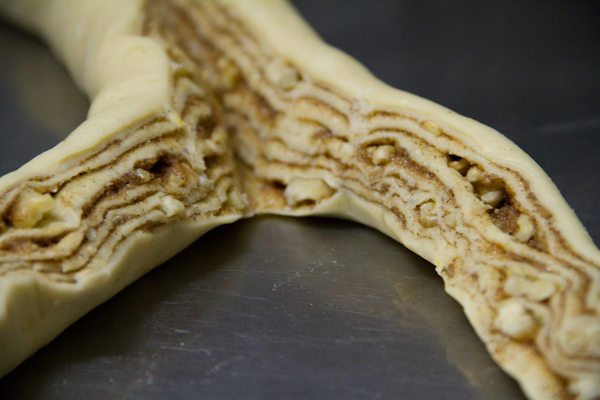
  • Once we have a sort of thin Swiss roll, we cut the log lengthwise down the middle, leaving one of the ends joined. When we cut it, we should see the alternating layers of dough and filling.

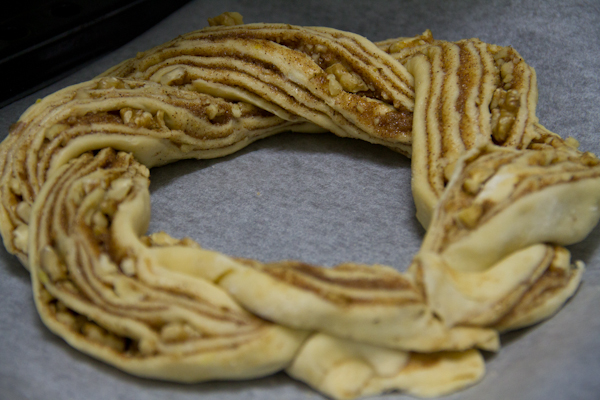
  • We cross each piece of dough to form a kind of braid (always keeping the layered side facing up).

  • Once everything is ‘braided’, we form a wreath and place it on a baking tray lined with parchment paper.

  • We bake for about 20 minutes.

  • While it’s baking, we prepare the glaze. To do this, we beat the egg whites a little with a fork and mix them with the confectioners’ sugar.

  • When we take the kringle out of the oven, we brush it with this glaze.

Pics and Cakes

Tips:

  • The lemon peel is optional. You can skip it or swap it for orange peel — for sure it’ll be delicious too.

  • If you want a whiter, thicker glaze, you can beat the egg whites with the sugar using an electric whisk. That’s how we made it, and that’s why the glaze looks like it does in the photo. If you beat it just with a fork, it’ll give the kringle a certain shine but it won’t be white and as thick.

  • Starting from this base, you can fill the dough with other nuts or even jam.

Pics and Cakes

[English version] ESTONIAN KRINGLE* *Ingredients: For the dough:

  • 30 g sugar

  • 1/2 lemon peel (only the yellow part)

  • 120 g milk

  • 30 g butter

  • 15 g fresh yeast

  • 1 egg yolk

  • 300 g strength

  • 1 pinch of salt

For the filling:

  • 50 g de butter (room temperature)

  • 60 g de sugar

  • 2 tbsp cinnamon

  • 50 g chopped walnuts

For the icing:

  • 20 g egg white

  • 50 g confectioners’ sugar

  • If you have a coffee grinder or food processor, place the sugar and the lemon peel on it and grind it until getting a sort of paste. If you don’t have a grinder, just mix sugar with grated lemon peel.

  • Heat the milk in the microwave and pour over the sugar.

  • Add the butter and yeast and stir well.

  • Add egg yolk and stir well again.

  • Then, add flour and salt. Mix with a spoon and fork and then knead the dough on a floury surface.

  • Make a dough ball and leave to rise into the bowl covered with cling film (until the dough has doubled in volume).

  • In the meanwhile, prepare the filling. Mix butter (room temperature) with sugar and cinnamon.

  • Preheat oven at 180º.

  • When the dough has doubled in volume, place on a floury surface and roll it out with a rolling pin until getting a rectangle (40 x 50 cm aprox.)

  • Spread the filling and sprinkle with chopped walnuts.

  • Roll up the dough (starting by the wider side).

  • Cut the log in half length-wise leaving one edge uncut.

  • Start braiding the two pieces, trying to keep the open layers exposed so the cut ends remain on top.

  • Pinch the ends together and form a wreath.

  • Bake for 20 minutes.

  • Prepare the icing. Whisk white eggs with a fork and add confectioners’ sugar. Mix well.

  • Out of the oven, brush the kringle with the sugar icing.

  • *Tips: - Lemon peel is optional. You can leave it out or use orange peel. For sure, it will be delicious too. - If you want a thicker and whiter sugar icing you can use an electric mixer with whisk attachment. The result will be more similar to our kringle shown in the picture. If you whisk only with fork you will have a lighter and clearer icing. - You can change the filling and use any nuts or jam you like.

24 de septiembre de 2013 · 5 min · Palstelera

Kringle Estonia

No solo es que parezca que llevamos siglos sin publicar sino que es cierto… ¡casi tres meses sin actividad bloguera en PiC! El verano ha sido un poco ajetreado pero aquí estamos de vuelta cargaditos con nuevas recetas para chuparse los dedos. Hoy os traigo una receta que podría considerarse el roscón de Reyes nórdico y que algunos dicen que su forma recuerda a los pretzels y la masa es tipo brioche. En fin, una maravilla dulce que hemos sacado de una revista de Thermomix pero que la hemos hecho sin ella para demostrar que cualquier receta es adaptable.

Pics and Cakes


¿Qué necesitamos?

Para la masa:

  • 30 g de azúcar

  • La piel de 1/2 limón (sólo la parte amarilla)

  • 120 g de leche

  • 30 g de mantequilla

  • 15 g de levadura prensada fresca

  • 1 yema de huevo

  • 300 g de harina de fuerza

  • **1 pizca de sal

Para el relleno:

  • 50 g de mantequilla (a temperatura ambiente)

  • 60 g de azúcar

  • 2 cucharadas de canela

  • 50 g de nueces picadas

Para el glaseado:

  • 20 g de clara de huevo

  • 50 g de azúcar glas


¿Cómo lo hacemos?

  • Si tenemos un molinillo eléctrico de café o una picadora, ponemos el azúcar con la piel de limón y trituramos bien hasta que el limón se integre en el azúcar y quede una especie de pasta. Si no lo tenemos podemos rallar la piel del limón y mezclarla con el azúcar.

  • Calentamos un poco la leche en el microondas y la añadimos al bol donde tenemos el azúcar con la piel de limón.

  • Añadimos la mantequilla y la levadura y removemos hasta que se integre bien.

  • Agregamos la yema de huevo y volvemos a mezclar bien.

  • Por último, incorporamos la harina y la sal. Removemos con la cuchara o tenedor y luego pasamos la masa a una superficie enharinada y amasamos con las manos.

  • Formamos una bola con la masa y la dejamos reposar en el bol tapado con film transparente haste que duplique su volumen.

  • Mientras tanto, vamos preparando el relleno. Para ello, mezclamos la mantequilla a temperatura ambiente con el azúcar y la canela.

  • Precalentamos el horno a 180º.

  • Cuando la masa ya haya duplicado su volumen, la ponemos sobre una superficie enharinada y la extendemos con un rodillo hasta obtener un rectángulo de 40 x 50 cm aprox.

  • Untamos la crema de relleno sobre ella y distribuimos las nueces por encima.

  • Enrollamos la masa (empezando por la parte más ancha).

  • Cuando tengamos una especie de brazo de gitano delgado cortamos el rollo por la mitad (de forma transversal) y dejando uno de los extremos unidos. Al cortarlo, tendremos que ver las capas de masa y relleno que se alternan.

  • Cruzamos cada parte de la masa para hacer una especie de trenza (siempre con la parte de las capas visibles hacia arriba.

  • Cuando esté todo ’trenzado’ formamos una rosca y la colocamos en una bandeja de horno con papel de hornear.

  • Horneamos durante 20 minutos aproximadamente.

  • Mientras se hornea, preparamos el glaseado. Para ello, batimos un poco las claras con un tenedor y las mezclamos con el azúcar glas.

  • Cuando saquemos el kringle del horno lo pintaremos con este glaseado.

Pics and Cakes

Consejos:

  • La piel del limón es opcional. Podéis omitirla o cambiarla por piel de naranja, seguro que también está riquísimo.

  • Si el glaseado lo queréis más blanco y consistente podéis batir las claras con el azúcar con una batidora de varillas eléctrica. Así es como lo preparamos nosotros y por eso el glaseado se ve en la foto. Si lo batimos simplemente con un tenedor le dará cierto brillo al kringle pero no será de color blanco y tan espeso.

  • Partiendo de esta base podéis rellenar la masa con otros frutos secos o incluso mermelada.

Pics and Cakes

[English version] ESTONIAN KRINGLE* *Ingredients: For the dough:

  • 30 g sugar

  • 1/2 lemon peel (only the yellow part)

  • 120 g milk

  • 30 g butter

  • 15 g fresh yeast

  • 1 egg yolk

  • 300 g strength

  • 1 pinch of salt

For the filling:

  • 50 g de butter (room temperature)

  • 60 g de sugar

  • 2 tbsp cinnamon

  • 50 g chopped walnuts

For the icing:

  • 20 g egg white

  • 50 g confectioners’ sugar

* *

  • If you have a coffee grinder or food processor, place the sugar and the lemon peel on it and grind it until getting a sort of paste. If you don’t have a grinder, just mix sugar with grated lemon peel.

  • Heat the milk in the microwave and pour over the sugar.

  • Add the butter and yeast and stir well.

  • Add egg yolk and stir well again.

  • Then, add flour and salt. Mix with a spoon and fork and then knead the dough on a floury surface.

  • Make a dough ball and leave to rise into the bowl covered with cling film (until the dough has doubled in volume).

  • In the meanwhile, prepare the filling. Mix butter (room temperature) with sugar and cinnamon.

  • Preheat oven at 180º.

  • When the dough has doubled in volume, place on a floury surface and roll it out with a rolling pin until getting a rectangle (40 x 50 cm aprox.)

  • Spread the filling and sprinkle with chopped walnuts.

  • Roll up the dough (starting by the wider side).

  • Cut the log in half length-wise leaving one edge uncut.

  • Start  braiding the two pieces, trying to keep the open layers exposed so the cut ends remain on top.

  • Pinch the ends together and form a wreath.

  • Bake for 20 minutes.

  • Prepare the icing. Whisk white eggs with a fork and add confectioners’ sugar. Mix well.

  • Out of the oven, brush the kringle with the sugar icing.

* *Tips: - Lemon peel is optional. You can leave it out or use orange peel. For sure, it will be delicious too. - If you want a thicker and whiter sugar icing you can use an electric mixer with whisk attachment. The result will be more similar to our kringle shown in the picture. If you whisk only with fork you will have a lighter and clearer icing. - You can change the filling and use any nuts or jam you like.


24 de septiembre de 2013 · 5 min · Palstelera

Chocolate and Salted Caramel Tart

Even though putting the words ‘caramel’ and ‘salted’ together in the same phrase sounds weird, it’s a delicious combination that I tried for the first time thanks to French delicatessens. So as soon as I saw this recipe on La receta de la felicidad I couldn’t resist giving it a go, and I knew it’d be a guaranteed success. Even those weird beings who aren’t crazy about chocolate end up liking it, thanks to the crunchy bite of the crust and the creaminess of the filling. So what are you waiting for to try it?

Pics and Cakes

What do we need?

For the special shortcrust pastry:

  • 250 g (2 cups) all-purpose flour

  • 30 g (1/4 cup) ground almonds

  • 150 g (2/3 cup) butter

  • 80 g (1/3 cup) sugar

  • 1 egg

  • 1 pinch of salt

  • 1 pinch of powdered vanilla

For the salted caramel sauce:

  • 70 g (1/3 cup) sugar

  • 70 ml (1/3 cup) heavy cream

  • 1 teaspoon butter

  • a pinch of salt

For the chocolate cream:

  • 500 ml (2 cups) heavy cream

  • 350 g (12 oz) dark chocolate

For the whipped cream:

  • 300 ml (1 1/4 cups) heavy whipping cream, very cold (at least 35% fat)

  • 2 heaping tablespoons of powdered sugar

  • Optional: cocoa powder for dusting on top

Pics and Cakes

How do we make it?

  • We start by preparing the crust. Mix the very cold butter, cut into small cubes, with the rest of the ingredients. You can use the dough attachment on your mixer or use a spoon and finish kneading by hand. It’ll come out crumbly and you’ll have to keep squeezing the butter with your hands to incorporate everything well, but don’t despair. Wrap in plastic wrap and chill in the fridge for half an hour.

  • Meanwhile, prepare a 24 to 26 cm (9.5 to 10 in) springform tin by lightly greasing it and placing a sheet of baking paper on the bottom.

  • Roll out the dough on a floured surface or between two sheets of baking paper or plastic wrap (so it doesn’t stick) until it’s about 3 mm (1/8 in) thick.

  • Roll the dough onto the rolling pin and unroll it over the tin. Press it well into the tin, patching any gaps with bits of dough. Trim the edges by running the rolling pin over the top of the tin and pressing down.

  • Put the tin with the dough in the fridge for 30 minutes.

  • Preheat the oven to 180°C (355°F).

  • Cover the bottom of the tart with baking paper and fill with dried chickpeas (just like when making quiches — this keeps the dough from rising in the oven). Bake the crust for about 25 minutes.

  • Take it out and once it’s cooled, unmold and place on a plate or tray.

  • Now we’ll prepare the salted caramel sauce. Have the cream and butter ready beforehand. Put the sugar in a saucepan over medium heat and wait without stirring until it turns into caramel (2 or 3 minutes). Once you have a golden caramel, lower the heat to minimum and add the butter, salt, and cream, stirring constantly until you get a smooth sauce. If any caramel lumps form, keep stirring vigorously over low-medium heat until they fully dissolve.

  • Once it’s cooled a bit, pour the caramel over the tart base and put it in the fridge for half an hour.

  • Next we make the chocolate cream. Bring the cream to a boil in a saucepan while you chop the chocolate. When it boils, remove from the heat and add the chopped chocolate. Let it sit for a few minutes and stir until you get a smooth cream. Once the chocolate cream has cooled a bit, pour it over the tart that you had reserved in the fridge and let it chill overnight.

  • Finally, whip the cream. Beat the very cold cream with the sugar using a whisk until it reaches the desired consistency (be careful not to overdo it or it’ll turn into butter).

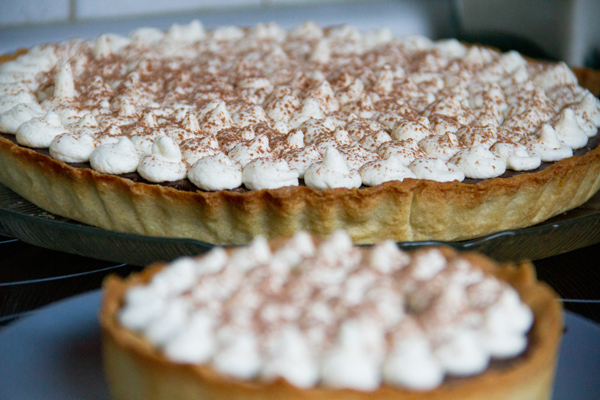
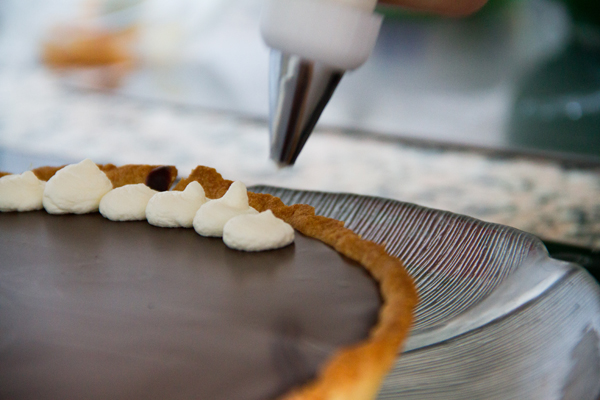
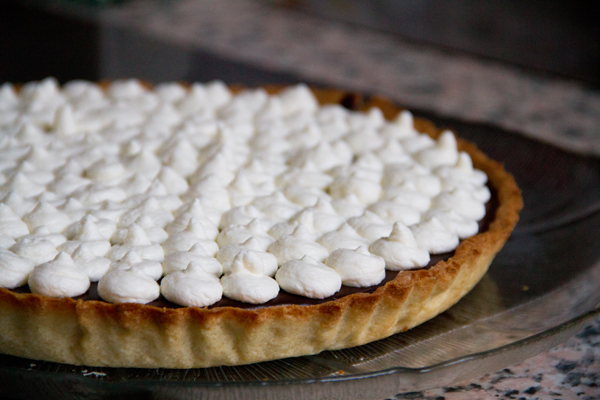
  • Put the whipped cream into a piping bag with a round tip and pipe little mounds of cream over the tart. Using a sieve, dust with cocoa powder and keep in the fridge until ready to serve.

Tips:

  • When whipping the cream you can use regular sugar, but store-bought powdered sugar will help keep the consistency longer since it usually contains a small amount of starch.

  • If you don’t want to even turn on the oven, you can swap the shortcrust base for a cookie base. Crush digestive-type cookies, for example, and mix with melted butter. Cover the tin pressing down well so it’s nice and compact, let it chill before pouring the caramel and you’re done.

  • If you don’t have a piping bag or tip, you can use a plastic bag (like a freezer bag) and snip a small hole in the corner.

Pics and Cakes

[English version] CHOCOLATE AND SALTED CARAMEL TART* *

For the crust:

  • *250 g all purpose flour *

  • *30 g powdered almonds *

  • *150 g butter, cold, cut into cubes *

  • *80 g sugar *

  • 1 egg

  • 1 pinch of salt

  • 1 pinch powdered vanilla

For the salted caramel sauce:

  • *70 g sugar *

  • *70 ml heavy cream *

  • 1 teaspoon butter

  • pinch of salt

For the chocolate cream:

  • *500 ml heavy cream *

  • *350 g dark chocolate *

For the whipped cream:

  • 300 ml heavy cream, very cold (1 cup aprox)

  • 2 tablespoons sugar

  • Optional: unsweetened cocoa powder for dusting

* *

  • Prepare the crust. Whizz all the ingredients in a food processor to a dough and finish by hand until getting a homogeneous dough. Wrap the dough and chill for 30 minutes. Roll out the pastry and line a deep 24-26 cm tart tin with it; patch any holes if crumbly. Cover and chill for at least 30 minutes.

  • Preheat oven to 180 ºC. Prick the tart shell all over with a fork or use baking beans and bake about 25 minutes.

  • Transfer to a rack and let cool.

  • Prepare the caramel sauce. Place sugar a small saucepan and bring to a boil over medium heat. Look for the caramel to turn a rich amber colour, then lower the heat and whisk in butter and cream (the mixture will bubble up, so be careful!). Pour caramel into cooled tart shell and let cool slightly; refrigerate 1/2 hour.

  • Prepare the chocolate cream. Chop the chocolate. Bring heavy cream to boil in a small saucepan over medium heat. Put chocolate into a medium bowl and pour in the hot cream. Let sit for a few minutes, then stir until smooth. Pour ganache evenly over tart and refrigerate 24 hours .

  • Before serving, prepare the whipped cream. In a bowl, using an electric mixer, beat the cream with the sugar until firm. Pipe the whipped cream on top of the pie and dust with some cocoa powdered if desired.

Tips:**- If you use confectioners’ sugar when whipping the cream, you’ll get a firmer cream.

- If you don’t want even to switch on the oven you can prepare the crust with biscuits. Just smash the biscuits and mix with melted butter. Cover the tart mold with it, pressing well with your fingers.Refrigerate before pouring the caramel sauce.

- If you don’t have piping bag, you can use a plastic bag instead.


16 de abril de 2013 · 6 min · Palstelera

Tarta de chocolate y caramelo salado

Aunque juntar las palabras ‘caramelo’ y ‘salado’ en la misma frase suene extraño, es una combinación deliciosa que probé por primera vez gracias a las delicatessen francesas. Por eso en cuanto vi esta receta en La receta de la felicidad no pude resistirme a probarla y sabía que sería un éxito asegurado. Incluso a aquellos seres extraños a los que no les apasiona el chocolate, les gusta por el toque crujiente de la base y la cremosidad del relleno. Así que no sé a qué estáis esperando para probarla.

 Pics and Cakes


¿Qué necesitamos?


Para la masa quebrada especial:

  • 250 g de harina

  • 30 g de almendra molida

  • 150 g de mantequilla

  • 80 g de azúcar

  • 1 huevo

  • 1 pizca de sal

  • 1 pizca de vainilla en polvo


Para la salsa de caramelo salado:

  • 70 g de azúcar

  • 70 ml de nata

  • una cucharadita de mantequilla

  • una pizca de sal


Para la crema de chocolate:

  • 500 ml de nata

  • 350 g de chocolate negro


Para la nata montada:

  • 300 ml de nata para montar muy fría (mínimo 35% de MG)

  • 2 cucharas colmadas de azúcar glas

  • Opcional: cacao en polvo para espolvorear por encima

 Pics and Cakes

¿Cómo lo hacemos?

  • Comenzamos preparando la base. Mezclamos la mantequilla muy fría cortada en cuadraditos con el resto de los ingredientes. Podemos utilizar un accesorio amasador de la batidora o utilizar una cuchara y terminamos de amasar con las manos. Se nos quedará desmigajado y tendremos que ir estrujando la mantequilla con las manos para poder incorporarlo bien pero no hay que desesperar. Envolvemos en film transparente y dejamos en la nevera media hora.

  • Mientras, preparamos un molde desmontable de 24 a 26 cm engrasándolo ligeramente y colocando una hoja de papel de hornear en la base.

  • Extendemos la masa con el rodillo sobre una superficie enharinada o entre dos papeles de hornear o film transparente (para que no se nos pegue) hasta dejarla de un grosor de 3 mm aproximadamente.

  • Enrollamos la masa sobre el rodillo y la vamos desenrollando sobre el molde. La colocamos presionando bien sobre el molde, cubriendo los huecos que pudieran quedar con trozos de masa. Eliminamos los bordes pasando el rodillo por encima del molde y presionando.

  • Metemos el molde con la masa 30 minutos en la nevera.

  • Precalentamos el horno a 180 º C.

  • Cubrimos el fondo de la tarta con papel de horno y rellenamos con garbanzos crudos (igual que cuando preparamos las quiches, esto es para que la masa no suba en el horno). Cocemos la base de nuestra tarta en el horno durante unos 25 minutos.

  • Sacamos y cuando esté fría, desmoldamos y ponemos sobre un plato o bandeja.

  • Ahora vamos a preparar la salsa de caramelo salado. Preparamos de antemano la nata y la mantequilla necesarias. Ponemos el azúcar en un cazo a fuego medio y esperamos sin mover a que se convierta en caramelo (2 ó 3 minutos). Cuando tengamos un caramelo dorado, bajamos el fuego al mínimo y  agregamos  la mantequilla, la sal y la nata removiendo constantemente hasta obtener una salsa homogénea. Si se nos ha hecho algún grumo de caramelo seguimos removiendo con energía a fuego bajo-medio hasta que se deshaga del todo.

  • Cuando se haya enfriado un poco, vertemos el caramelo sobre la base de la tarta y lo dejamos en la nevera media hora.

  • Seguimos preparando la crema de chocolate. Para ello, ponemos a hervir la nata en un cazo mientras que troceamos el chocolate. Cuando hierva, retiramos del fuego y agregamos el chocolate troceado. Dejamos reposar unos minutos y removemos hasta lograr una crema homogénea. Cuando la crema de chocolate se haya enfriado un poco, la vertemos sobre nuestra tarta que teníamos reservada en el frigorífico y la dejamos enfriar de un día para otro.

  • Por último, montamos la nata. Para ello, batimos con un batidor de varillas la nata muy fría con el azúcar hasta que tenga la consistencia deseada (cuidado con pasarnos o se convertirá en mantequilla).

  • Ponemos la nata en una manga con boquilla redonda y vamos depositando montoncitos de nata sobre la tarta. Con ayuda de un colador, espolvoreamos con cacao en polvo y reservamos en el frigorífico hasta el momento de servir.

Consejos:

  • Al montar la nata podéis utilizar azúcar normal pero el azúcar glas comprada ayudará a mantener la consistencia durante más tiempo ya que suele contener una pequeña cantidad de almidón.

  • Si no queréis encender ni siquiera el horno, podéis sustituir la base de masa quebrada por una base hecha con galletas. Para ello triturad galletas tipo digestive, por ejemplo, y mezclad con mantequilla derretida. Cubrid el molde presionando bien para que quede bien compacto, dejad enfriar antes de echar el caramelo y listo.

  • Si no tenéis manga pastelera ni boquilla, podéis utilizar una bolsa (por ejemplo, las de congelar) haciéndole un pequeño corte en la punta.

  Pics and Cakes

[English version] CHOCOLATE AND SALTED CARAMEL TART* *

For the crust:

  • *250 g all purpose flour *

  • *30 g powdered almonds *

  • *150 g butter, cold, cut into cubes *

  • *80 g sugar *

  • 1 egg

  • 1 pinch of salt

  • 1 pinch powdered vanilla

For the salted caramel sauce:

  • *70 g sugar *

  • *70 ml heavy cream *

  • 1 teaspoon butter

  • pinch of salt

For the chocolate cream:

  • *500 ml heavy cream *

  • *350 g dark chocolate *

For the whipped cream:

  • 300 ml heavy cream, very cold (1 cup aprox)

  • 2 tablespoons sugar

  • Optional: unsweetened cocoa powder for dusting

* *

  • Prepare the crust. Whizz all the ingredients in a food processor to a dough and finish by hand until getting a homogeneous dough. Wrap the dough and chill for 30 minutes. Roll out the pastry and line a deep 24-26 cm tart tin with it; patch any holes if crumbly. Cover and chill for at least 30 minutes.

  • Preheat oven to 180 ºC. Prick the tart shell all over with a fork or use baking beans and bake about 25 minutes.

  • Transfer to a rack and let cool.

  • Prepare the caramel sauce. Place sugar a small saucepan and bring to a boil over medium heat. Look for the caramel to turn a rich amber colour, then lower the heat and whisk in butter and cream (the mixture will bubble up, so be careful!). Pour caramel into cooled tart shell and let cool slightly; refrigerate 1/2 hour.

  • Prepare the chocolate cream. Chop the chocolate. Bring heavy cream to boil in a small saucepan over medium heat. Put chocolate into a medium bowl and pour in the hot cream. Let sit for a few minutes, then stir until smooth. Pour ganache evenly over tart and refrigerate 24 hours .

  • Before serving, prepare the whipped cream. In a bowl, using an electric mixer, beat the cream with the sugar until firm. Pipe the whipped cream on top of the pie and dust with some cocoa powdered if desired.

Tips:**- If you use confectioners’ sugar when whipping the cream, you’ll get a firmer cream.

- If you don’t want even to switch on the oven you can prepare the crust with biscuits. Just smash the biscuits and mix with melted butter. Cover the tart mold with it, pressing well with your fingers.Refrigerate before pouring the caramel sauce.

- If you don’t have piping bag, you can use a plastic bag instead.

* *


16 de abril de 2013 · 6 min · Palstelera

Petal Cake

We’ve had this recipe pending for a few days now, but since in the meantime we published our Whole Kitchen challenges, it had to be pushed back to this week. And well, what better week for a birthday cake… :-D I made the recipe following exactly the one @SandeeA did at La Receta de la Felicidad. So all credit for the explanation this time goes to her. My personal touch was just the little sugar bear.

Pics and Cakes

What do we need?

For the sponge cake (to make a tall cake, we’ll need to bake two sponges like this one, so double the quantities):

  • 250 g (about 1 cup + 2 tbsp) butter, room temperature

  • 250 g (1 ¼ cups) sugar

  • 4 eggs

  • 225 g (1 ¾ cups) all-purpose flour

  • 25 g (about 3 tbsp) cornstarch

  • half a packet of Royal-style baking powder (8 g, about 2 tsp)

For the chocolate buttercream:

  • 750 g (about 1 ⅔ lb) melting chocolate

  • 375 g (about 1 ⅔ cups) butter, room temperature

  • 100 g (about ¾ cup) powdered sugar

How do we make it?

  • Preheat the oven to 180 ºC (355 ºF).

  • Prepare a cake pan by greasing it with butter and dusting it lightly with flour.

  • In a large bowl, using a whisk or a spoon, mix the butter and sugar well until you get a smooth, creamy mixture.

  • Add the eggs one at a time, not adding the next one until the previous one is fully incorporated.

  • Add the flour, cornstarch, and baking powder and mix with a spatula or spoon until everything is well combined.

  • Pour the batter into the prepared pan, spreading it evenly.

  • Bake for 25-30 minutes at 180 ºC (355 ºF).

  • Take it out of the oven and wait a few minutes before unmolding.

  • Repeat these steps to make a second sponge cake just like the first one. (If you have two identical pans, you can make all the batter at once and divide it between both pans.)

  • Slice each sponge into two layers, trying to make them as even as possible.

  • Next, we start preparing the chocolate buttercream. First, we’ll melt the chocolate.

  • Chop it up and place it in a microwave-safe bowl. Heat it in 30-second intervals, stirring each time, until the chocolate is fully liquid. Let it cool for a few minutes.

  • Meanwhile, in another large bowl, beat the butter and sugar at top speed with a whisk until you get a fluffy, pale, smooth mixture (about 5 minutes).

  • Check that the chocolate you melted earlier has cooled down, and add it to the butter mixture. Beat a bit more until fully combined, and then move on to filling and decorating the cake.

  • Place the first sponge layer — the least perfect of the ones you made — on the plate you’ll be serving on, covered with some strips of parchment paper or printer paper, so it doesn’t get stained and you can pull them out easily afterwards.

  • Place a couple of spoonfuls of filling on this sponge layer and spread it evenly — it’s fine if some spills over the sides.

  • Place another sponge layer on top, pressing down gently and making sure it’s well aligned with the layer below. Add another two spoonfuls of filling and proceed as before.

  • Continue the same way with the rest of the layers. On top, place the most perfect sponge, with the bottom side facing up (it’s always the prettiest). If you don’t want the sponge layers to shift, since we’re about to cover and decorate the cake, you can stick a skewer down through the center of the cake, which you’ll remove once you’re done decorating.

  • Cover the cake with a first, very thin layer of chocolate buttercream — this is just to set things in place and hide any imperfections in the sponge layers.

  • Leave the chocolate cake in the fridge for 15 minutes so this layer firms up.

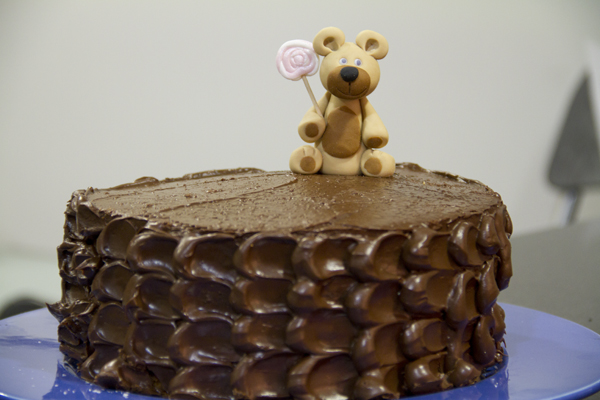
  • Using a piping bag fitted with a medium-sized round tip, pipe dots of buttercream onto the cake, forming a vertical line (4 dots, in my case).

  • Place a spatula on top of each dot and slide it to the right in a single motion (or to the left if you’re left-handed). Wipe the spatula clean and continue doing the same with the rest of the dots, remembering to always wipe the spatula between strokes.

  • Each time you finish a row of dots, grab the piping bag, create a new line of dots, and repeat the pattern across the whole cake. The spot where you finish the last row of petals will have some imperfections, and that should be the “back” of your cake.

  • If you’re not going to eat it the same day, store the chocolate cake preferably outside the fridge so the chocolate buttercream stays creamy, since the fridge tends to harden it.

Tips:

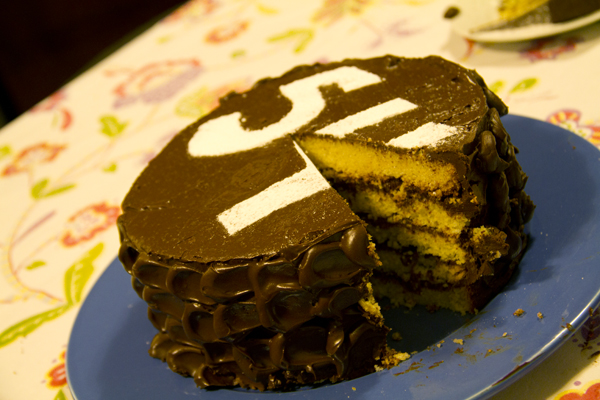
  • To decorate it, you can make a stencil out of a sheet of paper, cutting out the number of years the birthday person is turning, and dust it with powdered sugar.

  • I made this sugar bear out of modeling paste to crown the cake. I’ll do a tutorial soon so you can see how easy it is.

Pics and Cakes

[English version] PETALS CAKE* *Ingredients:

  • *250 g butter, room temperature *

  • *250 g sugar *

  • 4 eggs

  • *225 g all purpose flour *

  • *25 g corstarch *

  • *8 g baking powder *

For the chocolate buttercream:

  • 750 g dark chocolate, melted

  • *375 g butter, room temperature *

  • *100 g confectioners’ sugar *

  • Preheat oven to 180ºC

  • Prepare a cake pan (butter and flour the bottom and the sides of the pan).

  • In a large bowl, place butter and sugar, and mix well.

  • Add eggs one by one.

  • Add flour, cornstarch and baking powder, and beat until combined.

  • Pour batter into pan and bake for 25 minutes.

  • Leave the cake in its pan on a wire rack for 10 minutes and then turn out to cool.

  • Repeat the whole process to make another similar cake.

  • Now we are going to prepare the chocolate buttercream.

  • Using and electric mixer, cream butter and sugar, until light and fluffy (about 5 minutes). Add melted chocolate, that shall be cool, and mix well. Now the buttercream is ready to use.

  • Fill the cake layers with chocolate buttercream, and then frost it with a thin layer of buttercream.

  • Place the cake in the fridge for 15 minutes to set.

  • Place the remaining chocolate buttercream on a piping bag fitted with a medium sized round tip.

  • Create a row of dots (vertical), as shown on the pictures.

  • Using a spatula, spread every dot to the right, in one motion (or to the left if you are left-handed). Clean the spatula between every swipe.

  • Once you have spread one row of dots, add another row of dots and repeat the pattern until the whole cake is covered with “petals”.

  • If you are not going to eat the cake on the same day, please avoid keeping it in the fridge if possible, so that the chocolate buttercream remains creamy.

Tips:

  • You can create a template showing the number of the age that the special person is turning and then sprinkle with confectioners’ sugar.

  • On the top, I placed this sugar bear made by myself. Soon I will post a tutorial about how to make it with gum paste.


29 de noviembre de 2012 · 6 min · Palstelera

Tarta de pétalos

Teníamos pendiente publicar esta receta ya hace algunos días pero como entre medias publicamos nuestros retos de Whole Kitchen, ha quedado obligatoriamente pospuesta a esta semana. Y bueno, qué mejor semana para una tarta de cumpleaños… :-D La receta la hice siguiendo exactamente la que hizo @SandeeA en La Receta de la Felicidad. Así que todo mérito en la explicación esta vez se lo debemos a ella. Mi toque particular sólo fue el osito de azúcar.

Pics and Cakes

¿Qué necesitamos?

Para el bizcocho (para hacer una tarta alta, necesitaremos hacer dos bizcochos como éste, así que duplicad las cantidades):

  • 250 g mantequilla, a temperatura ambiente

  • 250 g azúcar

  • 4 huevos

  • 225 g harina normal

  • 25 g Maizena

  • medio sobre de levadura química tipo Royal (8 g)

Para la crema de chocolate:

  • 750 g de chocolate para fundir

  • 375 g de mantequilla a temperatura ambiente

  • 100 g de azúcar glass

¿Cómo lo hacemos?

  • Precalentamos el horno a 180 ºC

  • Preparamos un molde engrasándolo con mantequilla, y enharinándolo ligeramente.

  • En un bol amplio, con un batidor de varillas o con una cuchara, mezclamos bien la mantequilla con el azúcar, hasta obtener una mezcla homogénea y cremosa.

  • Añadimos los huevos de uno en uno, sin agregar el siguiente hasta que el anterior esté perfectamente integrado.

  • Añadimos la harina, la maizena y la levadura química y mezclamos con una espátula o cuchara, hasta que estén todos los ingrediente bien integrados.

  • Vertemos la mezcla en el molde que hemos preparado, distribuyéndola uniformemente.

  • Horneamos 25-30 minutos a 180º C.

  • Sacamos del horno, y esperamos unos minutos antes de desmoldar.

  • Repetimos estos pasos para hacer otro bizcocho igual. (Si tenéis dos moldes iguales podéis hacer toda la mezcla a la vez y repartirla entre los dos moldes).

  • Dividimos cada bizcocho en dos capas tratando de hacerlas lo más rectas posibles.

  • A continuación, comenzamos a preparar la crema de chocolate. Para ello, en primer lugar fundiremos el chocolate.

  • Lo troceamos y lo ponemos en un bol apto para microondas. Vamos programando de 30 en 30 segundos, removiendo de cada vez, hasta que el chocolate esté totalmente líquido. Dejamos enfriar unos minutos.

  • Mientras, en otro bol amplio, vamos batiendo la mantequilla con el azúcar a máxima velocidad con un batidor de varillas, hasta que obtengamos una masa esponjosa, blanquecina, y homogénea (unos 5 minutos)

  • Comprobamos que el chocolate que hemos fundido anteriormete esté ya frío, y lo agregamos a la crema de mantequilla. Batimos un poco más hasta integrarlo completamente, y procedemos a rellenar y decorar la tarta

  • Colocaremos el primer bizcocho, el menos perfecto de los que hayamos hecho, sobre el plato en el que vayamos a servir, cubierto con algunos recortes de papel de hornear o folios, para que no se manche y podamos retirarlos después con facilidad.

  • Colocamos sobre esta capa de bizcocho un par de cucharadas de relleno, y distribuimos uniformemente, no pasa nada porque se salga por los lados.

  • Ponemos otra capa de bizcocho encima, presionando ligeramente, y asegurándonos de que está bien alineado con el bizcocho inferior. Agregamos otras dos cucharadas de relleno, y procedemos igual que anteriormente.

  • Seguimos igual con el resto de capas. Arriba del todo colocamos el bizcocho que nos haya quedado más perfecto, con la parte de abajo hacia arriba (siempre es la más bonita). Si no queremos que se muevan las capas de bizcocho ya que a continuación vamos a cubrir y decorar la tarta, podemos usar una brocheta clavada en el centro de la tarta, que retiraremos cuando hayamos terminado de decorar.

  • Cubrimos nuestra tarta con una primera capa de crema de chocolate, muy fina, que servirá únicamente para fijar, y que se oculten las imperfecciones de las capas de bizcocho.

  • Dejamos la tarta de chocolate 15 minutos en el frigorífico, para que se solidifique esta capa.

  • Con una manga pastelera con boquilla redonda, de tamaño mediano, vamos depositando botones de crema en la tarta, formando una línea vertical (de 4 botones, en mi caso).

  • Colocamos una espátula sobre cada montoncito, y la deslizamos hacia la derecha, en un solo movimiento (o hacia la izquierda si sois zurdos). Limpiamos la espátula, y continuamos haciendo lo mismo con el resto de montoncitos, recordando limpiar siempre la espátula entre pasada y pasada.

  • Cada vez que terminemos con una fila de puntos, cogemos la manga, creamos una nueva línea de puntos, y repetimos el patrón a lo largo de toda la tarta. El punto donde finalicemos la última fila de pétalos quedará con imperfecciones, y deberá ser la “trasera” de nuestra tarta.

  • Si no la vamos a consumir en el día, conservamos la tarta de chocolate preferiblemente fuera del frigorífico, para que la crema de chocolate siga estando cremosa, ya que en el frigo tiende a endurecerse.

Consejos:

  • Para decorarla podéis hacer una plantilla con un folio, recortando el número de años que cumple el homenajeado y espolvorearla con azúcar glas.

  • Yo hice este oso de azúcar con pasta de modelar para coronar la tarta. Próximamente haré algún tutorial para que veáis lo fácil que es.

Pics and Cakes

[English version]  PETALS CAKE* *Ingredients:

  • *250 g butter, room temperature *

  • *250 g sugar *

  • 4 eggs

  • *225 g all purpose flour *

  • *25 g corstarch *

  • *8 g baking powder *

For the chocolate buttercream:

  • 750 g dark chocolate, melted

  • *375 g butter, room temperature *

  • *100 g confectioners’ sugar *

* *

  • Preheat oven to 180ºC

  • Prepare a cake pan (butter and flour the bottom and the sides of the pan).

  • In a large bowl, place butter and sugar, and mix well.

  • Add eggs one by one.

  • Add flour, cornstarch and baking powder, and beat until combined.

  • Pour batter into pan and bake for 25 minutes.

  • Leave the cake in its pan on a wire rack for 10 minutes and then turn out to cool.

  • Repeat the whole process to make another similar cake.

  • Now we are going to prepare the chocolate buttercream.

  • Using and electric mixer, cream butter and sugar, until light and fluffy (about 5 minutes). Add melted chocolate, that shall be cool, and mix well. Now the buttercream is ready to use.

  • Fill the cake layers with chocolate buttercream, and then frost it with a thin layer of buttercream.

  • Place the cake in the fridge for 15 minutes to set.

  • Place the remaining chocolate buttercream on a piping bag fitted with a medium sized round tip.

  • Create a row of dots (vertical), as shown on the pictures.

  • Using a spatula, spread every dot to the right, in one motion (or to the left if you are left-handed). Clean the spatula between every swipe.

  • Once you have spread one row of dots, add another row of dots and repeat the pattern until the whole cake is covered with “petals”.

  • If you are not going to eat the cake on the same day, please avoid keeping it in the fridge if possible, so that the chocolate buttercream remains creamy.

Tips:

  • You can create a template showing the number of the age that the special person is turning and then sprinkle with confectioners’ sugar.

  • On the top, I placed this sugar bear made by myself. Soon I will post a tutorial about how to make it with gum paste.


29 de noviembre de 2012 · 6 min · Palstelera