Scones

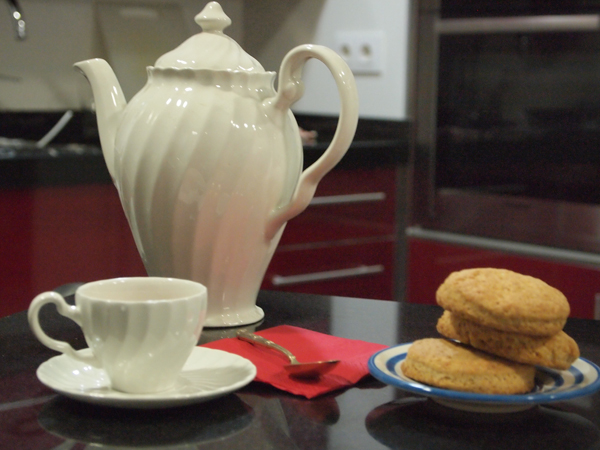
Whole Kitchen, in their Sweet Proposal for January, invites us to make a Scottish classic: Scones

We almost ran out of time with this recipe because — unusual for us — we made it the same day it was published. Luckily, it’s super easy and takes very little time. As usual, the baking time is what stretches the recipe out the most, but hey, the little wait is well worth it. We followed the recipe from www.joyofbaking.com
Pics and Cakes

What do we need?

  • 260 g (2 cups) all-purpose flour

  • 50 g (¼ cup) sugar

  • 1 sachet of Royal baking powder

  • a pinch of salt

  • 75 g (5 tbsp) very cold butter, cubed

  • 1 beaten egg

  • 120 ml (½ cup) heavy cream

How do we make it?

  • Preheat the oven to 190°C (375°F).

  • In a bowl, mix the flour with the sugar, baking powder and salt. Add the butter and rub it in with your fingertips — it should look like crumbs. Set aside.

  • In a separate bowl, mix the egg with the cream.

  • Combine both mixtures until well integrated, but don’t overwork the dough.

  • Roll out lightly until you have a fairly thick dough (about 1.5 cm / ½ inch). (Our first ones came out too thin.) Using a cookie cutter or a glass, cut out circles about 6 cm (2.5 inches) wide.

  • Place them on a baking tray lined with parchment paper and brush with a little milk.

  • Bake for 15 to 18 minutes, until golden.

  • Take them out of the oven and let them cool on a wire rack.

Tips:

  • We forgot to brush the scones with milk and they still turned out delicious, so if you forget too, it’s not the end of the world.

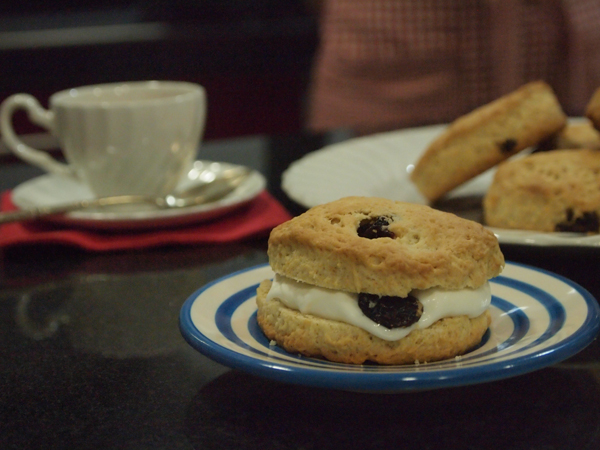
  • You can add chocolate chips, nuts, raisins… to the dough. This time we used dried cranberries.

  • To eat them, just split them in half and spread on butter and jam, whipped cream, lemon curd or anything else you fancy.
Pics and Cakes

[English version] SCONES* Ingredients: *

  • 260 g all-purpose flour

  • 50 g granulated white sugar

  • *1 sachet baking powder *

  • 1/4 teaspoon salt

  • 75 g cold unsalted butter

  • 1 large egg

  • 120 ml milk, half-and-half, or heavy cream

  • *Preheat oven to 190 degrees C. Line a baking sheet with parchment paper. *

  • In a large bowl, whisk or sift together the flour, sugar, baking powder and salt. Cut the butter into small pieces and blend into the flour mixture with a pastry blender, two knives, or with your fingertips. (The mixture should look like coarse crumbs.) In a small measuring cup whisk together the milk or cream and beaten egg. Add this mixture to the flour mixture. Stir just until combined. Do not over mix.

  • Transfer to a lightly floured surface and knead the dough gently four or five times and then pat into a 1,5cm of thickness. Then, using a 6 cm round cookie cutter, cut the dough into rounds. Place the rounds on the prepared cookie sheet, spacing a few centimetres apart. Brush the tops of the scones with a little cream.(This helps to brown the tops of the scones during baking.)

  • *Bake for about 15 -18 minutes or until nicely browned and a toothpick inserted into the center of a scone comes out clean. Remove from oven and transfer to a wire rack to cool. *

Tips:

*- We forgot brushing the scones with milk before baking. The result was wonderful anyway, so in case you forget it too, don’t panic! *

- You can add to the dough chocolate chips, nuts, raisins… We used dried cranberries.

*- You can serve them with butter and jam, marmalade, whipped cream, lemon curd or anything you like. *


Comments

Marivi (2013-01-26 00:39:22):

They look fantastic, and with the filling I’m sure they were even better.

Cristina (2013-01-26 00:55:54):

I really like your version, with cranberries they must be really good ;) and judging by the photos they look delicious!

A kiss!

PIlarHG (2013-01-26 00:59:03):

The same thing happened to me! I ended up making the recipe today too! Lucky it’s a quick one! They turned out great! ;)

Apfelstrudelkuchen (2013-01-26 01:55:06):

Hi!!!

Yeah, it’s true that nothing happens if you don’t brush them, because those scones look absolutely delicious.

A little kiss, Sandra von Cake

Palstelera (2013-01-26 12:48:42):

The truth is they were really tasty, and since I used the leftover cream to whip it up with a bit of sugar, even better. :-)

Palstelera (2013-01-26 12:49:39):

So glad you like them. The cranberries were a last-minute decision and they worked out really well.

Palstelera (2013-01-26 12:50:13):

Yes! Thank goodness they were quick :-)

Palstelera (2013-01-26 12:51:02):

Although now I’ll have to make them again to make them thicker and brushed with milk to see how they turn out :-)

Gri (2013-01-28 11:20:08):

I love your scones… they look fantastic!

A hug Gri http://eltallerdelosviernes.blogspot.com.es/2013/01/hoy-toca-receta-del-cwk.html

mara (2013-01-28 16:49:19):

They turned out so well and look so good with cranberries. I made mine plain because my daughters don’t like them. Here’s my version http://masdulcequesaladopuntocom.blogspot.com.es/2013/01/scones.html

zordor (2013-01-30 05:45:23):

This had a rhyme to it, but honestly I can’t remember what it was right now… :P

guillus (2013-02-27 20:27:45):

Scones! Do we also have to explain how to eat them? :P

guillus (2013-02-27 20:28:47):

Scones! Do we also have to explain how to eat them? :P And with clotted cream they’re even better…
25 de enero de 2013 · 5 min · Palstelera

Scones

Whole Kitchen en su Propuesta Dulce para el mes de enero nos invita a preparar un clásico escocés: Scones

Casi nos pilla el toro con la preparación de esta receta porque, raro en nosotros, pero la hemos hecho el mismo día de su publicación. Por suerte, la elaboración es sencillísima y se tarda muy poco tiempo. Como de costumbre, el tiempo de horneado es lo que más alarga nuestra receta pero bueno, la pequeña espera merece la pena. Hemos seguido la receta de www.joyofbaking.com

 Pics and Cakes


¿Qué necesitamos?

  • 260 g de harina

  • 50 g de azúcar

  • 1 sobre de levadura Royal 

  • una pizca de sal 

  • 75 g de mantequilla en cubitos muy fría 

  • 1 huevo batido 

  • 120 ml de nata


¿Cómo lo hacemos?

  •  Precalentamos el horno a 190ºC.

  • En un bol mezclamos la harina, con el azúcar, la levadura y la sal. Añadimos la mantequilla y mezclamos con ayuda de los dedos, deben parecer migas. Reservamos.

  • Por otro lado mezclamos los huevos con la nata.

  • Mezclamos ambos preparados hasta que estén bien integrados pero sin amasar demasiado.

  • Estiramos ligeramente con el rodillo hasta tener una masa más bien gordita (1'5 cm aprox.). (A nosotros nos quedaron los primeros demasiado finos). Con un cortante o un vaso cortamos círculos de unos 6 cm.

  • Colocamos en la bandeja del horno forrada con el papel para hornear y pintamos con un poco de leche.

  • Horneamos de 15 a 18 minutos, hasta que esté dorado.

  • Retiramos del horno y dejamos enfriar en una rejilla.


Consejos:

  • A nosotros se nos olvidó pintar los scones con leche y quedaron igualmente ricos así que si se os olvida no es el fin del mundo.

  • A la masa podéis añadirle pepitas de chocolate, nueces, pasas… En esta ocasión le hemos puesto arándanos rojos deshidratados.

  • Para comerlos, basta con abrirlos por la mitad y untar mantequilla y mermelada, nata montada, *lemon curd *o cualquier otra cosa que os guste.

Pics and Cakes

[English version] SCONESIngredients: *

  • 260 g all-purpose flour

  • 50 g granulated white sugar

  • *1 sachet baking powder *

  • 1/4 teaspoon salt

  • 75 g cold unsalted butter

  • 1 large egg

  • 120 ml milk, half-and-half, or heavy cream

* *

  • *Preheat oven to 190 degrees C. Line a baking sheet with parchment paper. *

  • In a large bowl, whisk or sift together the flour, sugar, baking powder and salt. Cut the butter into small pieces and blend into the flour mixture with a pastry blender, two knives, or with your fingertips. (The mixture should look like coarse crumbs.) In a small measuring cup whisk together the milk or cream and beaten egg. Add this mixture to the flour mixture. Stir just until combined. Do not over mix.

  • Transfer to a lightly floured surface and knead the dough gently four or five times and then pat into a 1,5cm of thickness. Then, using a 6 cm round cookie cutter, cut the dough into rounds. Place the rounds on the prepared cookie sheet, spacing a few centimetres apart. Brush the tops of the scones with a little cream.(This helps to brown the tops of the scones during baking.)

  • *Bake for about 15 -18 minutes or until nicely browned and a toothpick inserted into the center of a scone comes out clean. Remove from oven and transfer to a wire rack to cool. *


Tips:

*- We forgot brushing the scones with milk before baking. The result was wonderful anyway, so in case you forget it too, don’t panic!  *

- You can add to the dough chocolate chips, nuts, raisins… We used dried cranberries.

*- You can serve them with butter and jam, marmalade, whipped cream, lemon curd or anything you like. *


25 de enero de 2013 · 5 min · Palstelera

Ciabatta Bread

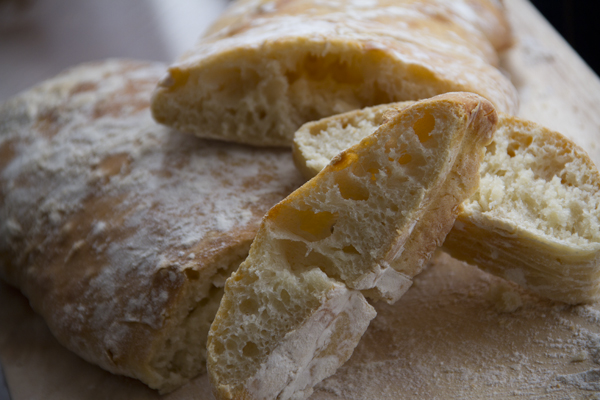
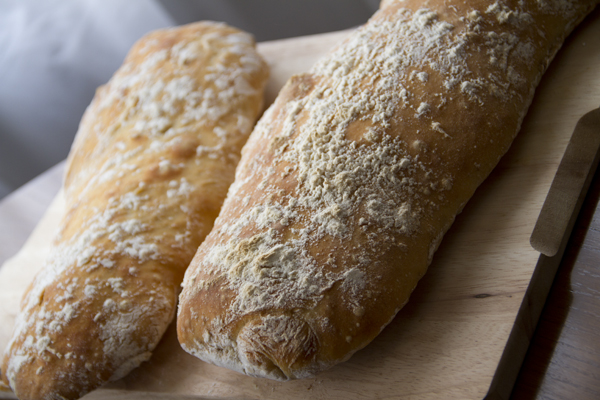
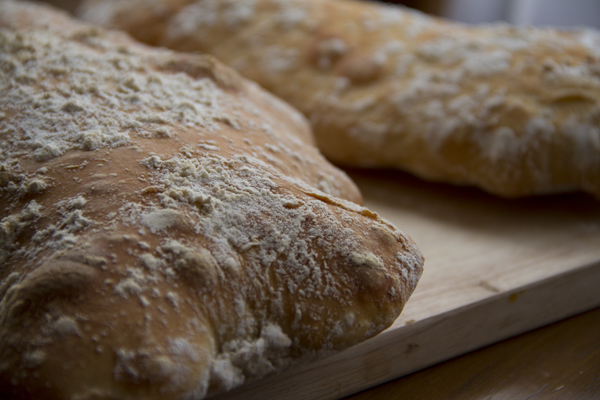
Whole Kitchen in their Savory Challenge for the month of November invites us to prepare an Italian classic: “Ciabatta”. I had been really wanting to make this recipe but I never thought it would turn out well, and… it turned out so well, yes indeed! It even looked like a real ciabatta. The recipe is slow because of the rising times, but it’s simple to make and the result is incredibly good.

Pics and Cakes

What do we need?

(For two loaves)

For the starter:

  • 2.5 g fresh yeast

  • 150 ml (2/3 cup) water

  • 3 tablespoons warm milk

  • 1/4 teaspoon honey or granulated sugar

  • 150 g (1.25 cups) bread flour

For the dough:

  • 2.5 g fresh yeast

  • 250 ml (1 cup) water

  • 1/2 tablespoon olive oil

  • 350 g (2.75 cups) bread flour

  • 1 and 1/2 teaspoons salt

Pics and Cakes

How do we make it?

  • First, we prepare the starter. Sprinkle the yeast into a large bowl with the water and milk. Let it sit for 5 minutes, then add the honey or sugar and stir to dissolve.

  • Add the flour and mix to form a loose dough. Cover the bowl with a kitchen towel and let it ferment for 12 hours or overnight.

  • Once the wait is over, we move on to the dough. Sprinkle the yeast into a small bowl with the water. Let it sit for 5 minutes; stir to dissolve. Add the yeast water and the olive oil to the starter and mix well.

  • Into the bowl, add the flour with the salt and mix to form a wet, sticky dough. Beat continuously with a wooden spoon for 5 minutes; the dough will turn fluffy and start to pull away from the sides, but it will still be too soft to knead.

  • Cover the dough with a kitchen towel. Let it ferment for about 3 hours, until the dough has tripled in size and is full of air bubbles. Generously flour two baking sheets and have extra flour ready to dust your hands.

  • Divide the dough in half while it’s still in the bowl. Tip half of the dough onto one of the sheets.

  • With your hands well coated in flour, shape it into a rectangular loaf about 30 cm (12 inches) long. Dust the loaf and your hands again with flour. Tidy and thicken it by running your fingers along the sides and gently tucking under the bottom of the dough. Repeat the same with the other half.

  • Uncovered, let the loaves rise for about 20 minutes; they will spread out and grow in volume.

  • Put them in the oven, preheated to 220°C (430°F), and bake for 30 minutes until the loaves have risen, are golden brown, and sound hollow when tapped on the bottom. Let cool on a wire rack.

Tips:

  • It’s a very sticky dough that you barely have to work with your hands. That’s why, in the final steps, it’s important to keep your hands well covered in flour and not handle the dough too much, since otherwise half of it will end up stuck to you.

  • I use the pressed baker’s yeast you can find in cubes in the supermarket in the bakery/pastry section, always refrigerated. I buy a bunch and freeze them, so I always have some on hand whenever I need it. That said, it’s important to keep in mind that frozen yeast loses a bit of its “power”, so you’ll need to add a little more than what the recipe calls for.

  • When baking, I put both sheets in at the same time and after 20 minutes I swapped them so that both loaves cooked evenly on both sides.

Pics and Cakes


Comments

Marisa (2012-11-22 12:51:05):

She brought a piece home for me and it’s awesome, delicious, amazing… mmm, I want more!

tía pi (2012-11-22 18:13:13):

It’s a pleasure how well you explain everything and the tips you give. I promise to make it and tell you how it turns out.

Angeles (2012-11-22 22:35:32):

It looks fantastic, just like an authentic Italian ciabatta.

marmota zampona (2012-11-24 19:27:46):

I’m going to give it a try right now.

22 de noviembre de 2012 · 4 min · Palstelera

Pan de chapata

**Whole kitchen en su Propuesta Salada para el mes de noviembre nos invita a preparar un clásico italiano “Ciabatta”. **Tenía muchas ganas de hacer esta receta pero ni de lejos pensé que me iba a quedar bien y… qué bien quedó, ¡sí, señor! Si hasta parecía una chapata de verdad. La receta es lenta por los tiempos de levado pero su elaboración es sencilla y el resultado es increíblemente bueno.

Pics and Cakes

¿Qué necesitamos?

(Para dos panes)

Para la masa madre:

  • 2,5 g de levadura fresca

  • 150 ml de agua

  • 3 cucharadas de leche tibia

  • 1/4 cucharadita de miel o azúcar granulada

  • 150 gr de harina de fuerza

Para la masa:

  • 2,5 g de levadura fresca

  • 250 ml de agua

  • 1/2 cucharada de aceite de oliva

  • 350 g de harina de fuerza

  • 1 y 1/2 cucharadita de sal

Pics and Cakes

¿Cómo lo hacemos?

  • Primero preparamos la masa madre. Esparcimos la levadura en un recipiente grande con agua y leche. Dejamos durante 5 minutos, después añadimos la miel o el azúcar y revolvemos para que se disuelva.

  • Añadimos la harina y mezclamos para formar una masa floja. Tapamos el cuenco con un paño de cocina y dejamos fermentar durante 12 horas o toda la noche.

  • Pasado el tiempo de espera, procedemos a hacer la masa. Esparcimos la levadura en un cuenco pequeño con agua. Dejamos durante 5 minutos; revolvemos para que se disuelva. Añadimos el agua con levadura y el aceite de oliva a la masa madre y mezclamos bien.

  • En el recipiente echamos y mezclamos la harina con la sal para formar una masa húmeda y pegajosa. Batimos sin parar con una cuchara de madera durante 5 minutos; la masa quedará esponjosa y empezará a despegarse, pero seguirá demasiado blanda para amasar.

  • Tapamos la masa con un paño de cocina. Dejamos fermentar durante unas 3 horas, hasta que la masa triplique su tamaño y se llene de burbujas de aire. Enharinamos generosamente dos bandejas de horno y preparamos harina adicional para echárnosla en las manos.

  • Dividimos la masa por la mitad mientras está en el cuenco. Volcamos la mitad de la masa sobre una de las bandejas.

  • Con las manos bien recubiertas de harina, formamos un pan rectangular, de aproximadamente 30 cm. de largo. Espolvoreamos el pan y las manos nuevamente con harina. Acomodamos y engrosamos recorriendo los costados con los dedos y llevando suavemente hacia adentro de la masa por debajo. Repetimos lo mismo con la otra mitad de la masa.

  • Sin tapar, dejamos fermentar los panes unos 20 min; se desparramarán y aumentarán de volumen.

  • Metemos en el horno previamente calentado a 220ºC y dejamos 30 minutos hasta que los panes se hinchen, adquieran un color dorado y suenen a hueco cuando los golpeemos en la base. Dejamos enfriar sobre una rejilla metálica.

Consejos:

  • Es una masa muy pegajosa que apenas hay que trabajar con las manos. Por eso, en los últimos pasos es importante tener las manos bien cubiertas de harina y no manosear mucho la masa ya que sólo conseguiríamos que se nos quedase la mitad de ella pegada a nosotros.

  • Yo utilizo la levadura de panadería prensada que podemos encontrar en cubitos en el supermercado en la parte de panadería/pastelería pero siempre refrigerada. Compro muchos y los congelo, así cada vez que lo necesito lo tengo a mano. Eso sí, es importante tener en cuenta que la levadura congelada pierde un poco de su “poder” así que habrá que echar un poquito más de cantidad de la que nos indica la receta.

  • A la hora de hornear, yo metí las dos bandejas a la vez y pasados 20 minutos las intercambié para que se hicieran bien los dos panes por las dos caras.

 Pics and Cakes

[English version] CIABATTA BREAD* *Ingredients:

(for two loaves)

For the sourdough (starter):

  • 2,5 g fresh yeast

  • 150 ml water

  • 3 tbsp warm milk

  • 1/4 tsp honey or sugar

  • 150 gr strong flour

  • For the dough:*
  • 2,5 g fresh yeast

  • 250 ml water

  • 1/2 tbsp olive oil

  • 350 g strong flour

  • 1 y 1/2 tsp salt

* *

  • *First, start by preparing the sourdough. Put the yeast into a large bowl with water and milk. Let the dough stand for 5 minutes and then add sugar/honey and stir well. *

  • Add the flour until having a loose dough. Cover with a clean cloth and let ferment for 12 hour or the whole night.

  • *After fermentation time, make the dough. Put yeast into a bowl with water. Let it stand for 5 minutes; stir well. Add this water with yeast and the olive oil to the sourdough. Stir well. *

  • *Add flour and salt and stir well using a wooden spoon. The result will be a wet and sticky dough. Keep beating for 5 minutes until getting a fluffy dough a bit less sticky (but still too much to knead). *

  • Cover with a kitchen cloth and let stand for 3 hours (the size will triple and some bubbles will appear inside). Scatter flour into two baking pans and in your hands.

  • Split the dough into two halves. Put one of the part into one baking pan.

  • *With hands covered by flour, shape the ciabatta bread (30 cm long) creating a rectangle. Repeat the same steps with the other half of dough. *

  • *Let it stand uncovered for 20 minutes. They will become bigger and lose its perfect shape. *

  • *Put into oven (preheated to 220ºC) and bake for 30 minutes until they are golden brown and bigger. Tap the bottom of the bread with your fingers and the bread will sound hollow when it’s done. Leave cool on a rack. *

* *

Tips:

*- It’s a very sticky dough very difficult to knead. It’s needed to have hands covered by flour and not kneading the dough too much. *

-  I usually use fresh yeast in cubes (sold in supermarkets). I buy several cubes and freeze them to use them whenever I want. However, you should take into account that frozen yeast will lose part of its “power” so you will need to use an amount slightly bigger than the amount indicated in the recipe.

*- For baking, I put both baking pans at the same time. After first 20 minutes I swaped their positions to have both loaves well done. *


22 de noviembre de 2012 · 6 min · Palstelera

Donuts

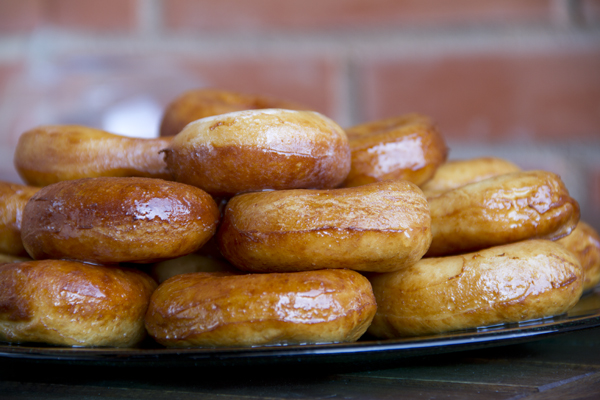
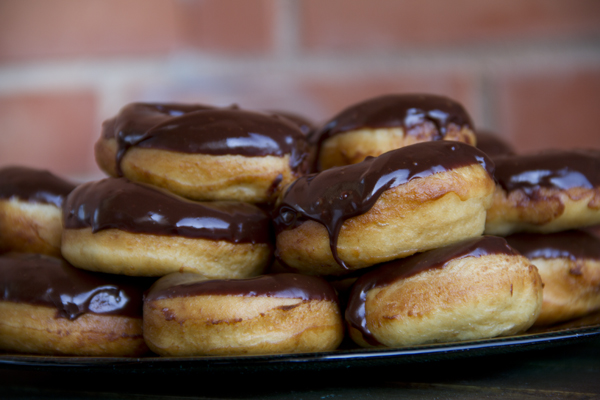
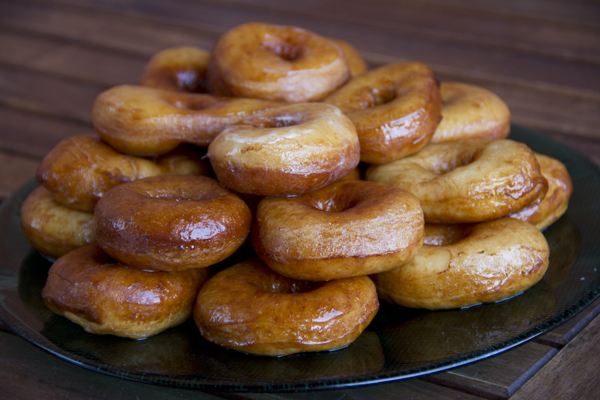
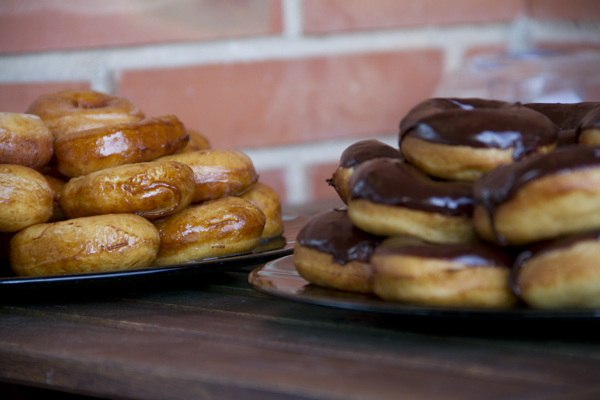
Creo que sin duda alguna éste es uno de los mejores descubrimientos culinarios que he hecho en mi vida. Por increíble que parezca el sabor es muy parecido a los comerciales, la masa es muy esponjosa, no se siente grasienta como la de algunos donuts de panadería y la cobertura de chocolate es sencillamente, magnífica. El único problema que tienen, es que son altamente adictivos… Os lo advierto, una vez que los probéis querréis repetir y repetir. Pero bueno, creo que merece la pena.

Pics and Cakes

¿Qué necesitamos?

  • 300 gr. de harina de fuerza

  • 200 gr de harina normal

  • 80 gr. de azúcar

  • 5 gr. de sal

  • 20 gr. de leche en polvo

  • 2 sobres de levadura de panadería

  • 230 gr. de agua templada

  • 1 huevo mediano

  • 40 gr. de manteca o margarina (nosotros usamos Crisco que es una grasa vegetal inolora e insípida)

  • 2 cucharaditas de esencia de naranja


Para el glaseado de azúcar:

  • 200 g azúcar glas

  • 1 cucharadita de mantequilla

  • Un chorrito de zumo de limón

  • Agua

Para el glaseado de chocolate:

  • 200 g azúcar glas

  • 1 cucharadita de mantequilla

  • 150 g chocolate para postres

  • Agua


Pics and Cakes

¿Cómo lo hacemos?

  • Mezclamos bien los ingredientes secos: harinas, azúcar, sal, leche en polvo y la levadura.

  • Añadimos el agua, ni caliente ni demasiado fría, a temperatura ambiente, el huevo batido y la esencia de naranja. Recordad, si el agua está caliente “matará la levadura”, si está muy fría tardará más tiempo en fermentar. Amasamos durante 8 minutos aproximadamente.

  • Añadimos la materia grasa y amasamos hasta que no se nos pegue a las manos. Es posible que necesitemos añadir más harina pero no lo sabremos hasta que no hayamos incorporado la manteca del todo. La textura resultante debe ser homogénea y elástica.

  • Formamos una bola y dejamos reposar unos 45 min. No pasa nada si lo dejamos más tiempo.

  • Pasado ese tiempo, amasamos un poco y estiramos del tamaño de 1 cm. de espesor. Si tenemos un cortapastas de donuts, perfecto. Si no con un cortador redondo (o con un vaso) hacemos los círculos y con un cortador más pequeño el círculo interior. Para el agujero del centro, nosotros hicimos el agujero con el dedo y lo agrandamos un poco (la masa es muy elástica así que no se notará la irregularidad).

  • Dejamos reposar en una bandeja sobre papel de hornear durante 1 hora mínimo para que vuelvan a crecer.

  • Freímos en aceite de girasol (si utilizamos aceite de oliva le dará demasiado sabor). El aceite no tiene que estar muy caliente ya que se queman enseguida. En cuanto los echemos a la sartén empezarán a hincharse. Los dejamos unos segundos y les damos la vuelta para que se doren por la otra parte.

  • Los sacamos y escurrimos en papel absorbente y todavía calientes, los bañamos con el glaseado de azúcar. Si los bañamos en glaseado de chocolate no hace falta que estén calientes.

  • Para hacer el glaseado de azúcar, derretimos un poco la mantequilla en el microondas y la mezclamos bien con el azúcar glas y un chorrito de limón. Añadimos unas cucharadas de agua hasta obtener una papilla ligera de color blanquecino.

  • Para el glaseado de chocolate, mezclamos el azúcar glas con unas cucharadas de agua (que nos quede de nuevo una papilla ligera). Derretimos el chocolate con la mantequilla en el microondas y una vez deshecho, lo añadimos a nuestra papilla de agua y azúcar. Si está demasiado espeso podemos añadir un poco más de agua. Si por el contrario, está demasiado duro, lo podemos dejar enfriar.

  • Para bañar los donuts en el glaseado de azúcar los sumergimos en el bol con el glaseado para que se pegue por todas partes. En cambio, para el glaseado de chocolate, sólo los bañaremos por una cara.


Pics and Cakes

Consejos:

  • Parece complicado pero no lo es. Simplemente hay que disponer de tiempo para hacerlos ya que es muy importante respetar los tiempos de ‘subida’ de la masa.

  • Es importante que la levadura sea de panadería y que la leche sea en polvo ya que si no, variarán nuestras proporciones de ingredientes secos y no obtendremos el mismo resultado.

  • A la hora de freír los donuts, hazlo de uno en uno o si es una sartén grande puedes poner 2 ó 3 máximo. De lo contrario, corres el riesgo de que se te quemen.


Pics and Cakes

*[English version] DOUGHNUTS ** *Ingredients:

  • 300 g strong flour

  • 200 g flour

  • 80 g sugar

  • 5 g salt

  • 20 g powdered milk

  • 2 sachets of dry yeast

  • 230 g warm water

  • 1 medium size egg

  • 40 g fat or margarine (we use Crisco)

  • 2 tsps orange flavour

  • *For sugar icing:
  • 200 g confectioners’ sugar

  • 1 tsp butter

  • Lemon juice

  • Water

For chocolate icing:

  • 200 g confectioners’ sugar

  • 1 tsp butter

  • 150 g chocolate

  • Water


  • Mix dry ingredients into a large bowl (flours, sugar, salt, powdered milk and yeast).

  • Add warm water, whisked egg and orange flavour. Remember, too hot water will ‘kill’ the yeast, too cold water will make fermentation slower. Knead for 8 minutes.

  • Add fat and keep kneading until having a non-sticky dough. You may need to add some more flour. The resulting texture should be a homogenous and elastic dough.

  • Make a ball and set aside for 45 minutes or more.

  • After this time, knead it and roll it out (1 cm). Use a round biscuit cutter to make the circles and use a smaller one to make the inner circle. You can also make the inner hole with your fingers. If you have a special doughnut cutter, it will be perfect.

  • Let the dough stand (already on the doughnut shape) again for 45 minutes on a baking tray covered by baking paper.

    • Deep fry in sunflower oil (don’t use olive oil because it will give them too strong flavour). Be careful, it will be fried very soon. Leave them some seconds and then turn them around until golden brown.*
  • Take them out and place on kitchen paper. Still hot, covered them with the sugar icing. If you use chocolate icing, they don’t need to be hot.

  • For sugar icing, melt butter in the microwave and mix with confectioners’ sugar and a trickle of lemon juice. Add some tbsp of water and stir well. You need a white thick soup.

  • For chocolate icing, mix confectioners’ sugar with some tbsp of water (you will need again a white thick soup). Melt chocolate with butter in the microwave and mix with the sugar mixture. If it’s too thick, you can add some more water. However, if it’s too liquid, you can let it cool for a while.

  • To cover the doughnuts with the sugar icing, plunge them into the bowl and cover both sides. However, for the chocolate icing, cover only one side of the doughnut.

    • Tips:*

*- It may seem complicated but it’s not. You only need time to do it because the rising times for the dough are essential for the success of the recipe. *

*- You need dry yeast and powdered milk to keep the proportion of dry ingredients and get perfect results. *

- When frying the doughnuts, take your time. Fry only one by one or, if you are using a large pan, 2 or 3 at the same time maximum. Otherwise, you risk to have them all burnt.


Pics and Cakes


1 de noviembre de 2012 · 8 min · Palstelera

Doughnuts

I think this is hands-down one of the best culinary discoveries I’ve made in my life. As unbelievable as it sounds, the flavor is really close to the store-bought ones — the dough is super fluffy, it doesn’t feel greasy like some bakery doughnuts, and the chocolate glaze is simply magnificent. The only problem is that they’re highly addictive… I’m warning you: once you try them, you’ll want to make them again and again. But hey, I think it’s worth it.

Pics and Cakes

What do we need?

  • 300 g (2.5 cups) bread flour

  • 200 g (1.5 cups) all-purpose flour

  • 80 g (1/3 cup + 1 tbsp) sugar

  • 5 g (1 tsp) salt

  • 20 g (3 tbsp) powdered milk

  • 2 packets of active dry yeast

  • 230 g (1 cup) warm water

  • 1 medium egg

  • 40 g (3 tbsp) shortening or margarine (we use Crisco, which is an odorless and tasteless vegetable fat)

  • 2 teaspoons orange extract

For the sugar glaze:

  • 200 g (1.75 cups) confectioners’ sugar

  • 1 teaspoon butter

  • A splash of lemon juice

  • Water

For the chocolate glaze:

  • 200 g (1.75 cups) confectioners’ sugar

  • 1 teaspoon butter

  • 150 g (5.3 oz) baking chocolate

  • Water

Pics and Cakes

How do we make them?

  • Mix the dry ingredients well: flours, sugar, salt, powdered milk and yeast.

  • Add the water — neither hot nor too cold, at room temperature — along with the beaten egg and the orange extract. Remember: if the water is hot it will “kill the yeast,” and if it’s too cold the dough will take longer to rise. Knead for about 8 minutes.

  • Add the fat and keep kneading until the dough no longer sticks to your hands. You might need to add more flour, but you won’t know until the shortening is fully incorporated. The resulting texture should be smooth and elastic.

  • Form a ball and let it rest for about 45 minutes. It’s fine to let it go longer.

  • After that time, knead it a bit and roll it out to about 1 cm (3/8 inch) thick. If you have a doughnut cutter, perfect. If not, use a round cutter (or a glass) to make the circles, and a smaller one for the inner circle. For the center hole, we just made it with our finger and stretched it a little (the dough is very elastic, so any irregularity won’t show).

  • Let them rest on a tray lined with parchment paper for at least 1 hour so they can rise again.

  • Fry in sunflower oil (if you use olive oil it’ll give them too much flavor). The oil shouldn’t be too hot or they’ll burn right away. As soon as you drop them in the pan they’ll start puffing up. Leave them for a few seconds and flip them so they brown on the other side.

  • Take them out and drain on paper towels, and while they’re still warm, dip them in the sugar glaze. If you’re using the chocolate glaze, they don’t need to be warm.

  • To make the sugar glaze, melt the butter a bit in the microwave and mix it well with the confectioners’ sugar and a splash of lemon. Add a few tablespoons of water until you get a light, whitish slurry.

  • For the chocolate glaze, mix the confectioners’ sugar with a few tablespoons of water (again, you want a light slurry). Melt the chocolate with the butter in the microwave and once melted, add it to the sugar-and-water mixture. If it’s too thick, add a bit more water. If on the other hand it’s too runny, let it cool down.

  • To coat the doughnuts in the sugar glaze, dip them into the bowl so the glaze sticks all over. For the chocolate glaze, only dip one side.

Pics and Cakes

Tips:

  • It looks complicated but it isn’t. You just need time, because respecting the dough’s rising times is really important.

  • It’s important that the yeast is bread yeast (not baking powder) and that the milk is powdered — otherwise your dry ingredient ratios will change and you won’t get the same result.

  • When frying the doughnuts, do them one at a time, or if you have a large pan, 2 or 3 at most. Otherwise you risk burning them.

Pics and Cakes

Pics and Cakes


1 de noviembre de 2012 · 5 min · Palstelera

Fresh Stuffed Pasta

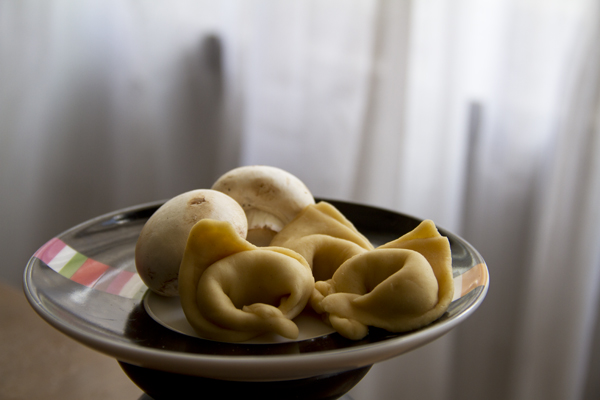
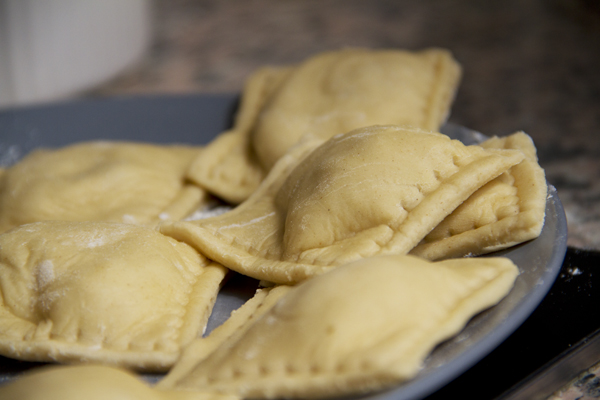
Whole Kitchen in their Savory Proposal for the month of September invites us to make an Italian classic: “Stuffed Pasta.” With this recipe we kick off a new adventure on this amazing food blog, where every month we’re challenged to make a savory dish and a sweet one. We love the idea — it’s original and pretty useful, since it pushes you to make dishes you might not normally tackle, and it also lets you check out what the other participants come up with.

Pics and Cakes

What do we need?

(Serves 4)

  • For the dough:
  •   300 g (2.5 cups) flour
    
  •   1 egg and 1 egg white
    
  •   2 tbsp olive oil
    
  •   1/2 tsp salt
    
  •   1 tsp vinegar
    
  • For the filling:
  •   2 small onions, finely chopped
    
  •   1 clove of garlic, finely chopped
    
  •   300 g (10.5 oz) mushrooms
    
  •   2 tbsp parsley
    
  •   Salt
    
  •   40 g (1.5 oz) aged cheese
    
  • For the sauce:
  •   200 ml (3/4 cup + 1 tbsp) heavy cream
    
  •   4 slices of bacon (thick-cut)
    
  •   Salt and pepper
    

Pics and Cakes

How do we do it?

  • Put the flour in a bowl, make a well in the center, and add the egg, the egg white, the salt, the oil, and the vinegar.

  • Knead until you get an elastic dough, adding a splash of water if needed.

  • Wrap the dough in plastic wrap and let it rest in the fridge for at least an hour.

  • Heat a little oil in a large pan, add the onions, garlic, and mushrooms. Cook gently over low heat until all the liquid has evaporated.

  • Stir in the parsley and season. Add the finely chopped aged cheese and mix well (with the heat off). Let it cool.

  • Once the dough has rested, divide it in two and roll out one half with a rolling pin until very thin. Ideally you’d use a pasta machine, but not everyone has one at home, so a rolling pin will do the trick.

  • Place small mounds of filling on the pasta sheet, leaving space between them.

  • Roll out the second half of the dough very thin and lay it over the first one. With your hands, press around the mounds to shape the ravioli.

  • Finally, cut out the ravioli with a round cutter (like a pizza cutter) with fluted edges. Set the ravioli aside while you prepare the sauce.

  • If instead of ravioli you’d rather make tortellini, roll out the dough very thin, fill it, and fold as shown in this [video](

{{}}

).

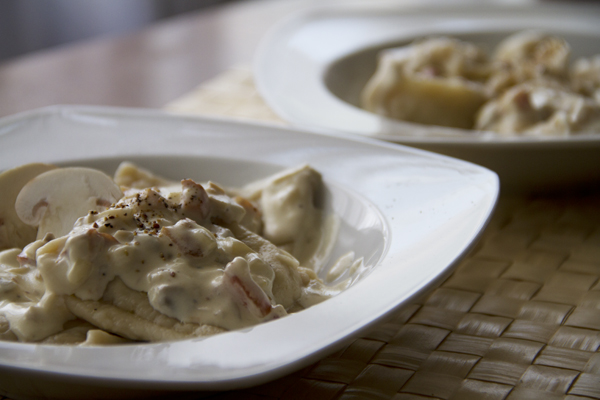
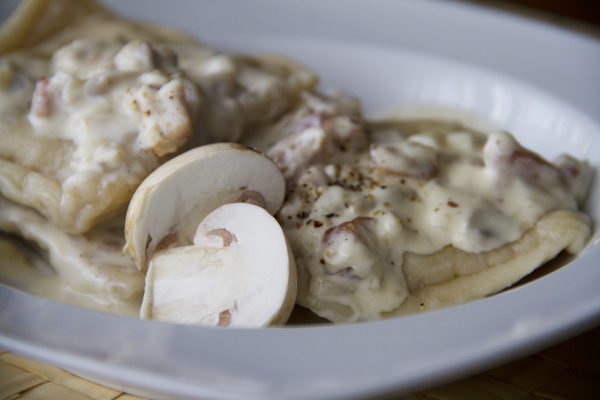
  • For the sauce, use the leftover filling. Sauté the bacon cut into small cubes, add the leftover filling and the cream, and bring to a boil. Simmer for a few minutes and adjust salt and pepper to taste.

  • Cook the pasta, drain it, add the sauce, and… buon appetito!

Pics and Cakes

Tips:

  • The dough has to be very thin. If you’re using a rolling pin, that means once you think it’s thin enough, roll it out at least three more times. I also recommend making your ravioli or tortellini small, since they’ll grow when cooked.
  • If you don’t have a pasta cutter, you can use a regular knife, but make sure to seal the edges well afterward or you’ll lose the filling during cooking. You can seal them with your fingers, a fork, or the edge of a serrated knife.
  • Our pasta took quite a while to cook (15 minutes) because the pieces were too big and chunky.

Pics and Cakes


18 de septiembre de 2012 · 4 min · Palstelera

Pasta fresca rellena

Whole kitchen en su Propuesta Salada para el mes de septiembre nos invita a preparar un clásico italiano “Pasta Rellena”. Y con esta receta empezamos una nueva andadura de este increíble blog culinario en el que cada mes nos retan a preparar una receta salada y una dulce. La idea nos parece original y bastante útil ya que te anima a hacer platos que, tal vez, no harías normalmente y además te permite ver los resultados de los demás participantes.

 Pics and Cakes

¿Qué necesitamos?

**(4 personas) **

  • Para la masa: -       300 g de harina -       1 huevo y 1 clara de huevo -       2 cucharadas de aceite de oliva -       1/2 cucharita de sal -       1 cucharita de vinagre

  • Para el relleno: -       2 cebollitas muy picadas -       1 diente de ajo muy picado -       300 g de champiñones -       2 cucharadas de perejil -       Sal -       40 g de queso curado

  • Para la salsa: -       200 ml de nata -       4 lonchas de bacon (grueso) -       Sal y pimienta

Pics and Cakes

¿Cómo lo hacemos?

  • Ponemos la harina en un cuenco, hacemos un hueco en el centro y añadimos el huevo, la clara, la sal, el aceite y el vinagre.

  • Amasamos hasta obtener una masa elástica y añadimos un poco de agua si fuera necesario.

  • Envolvemos la masa en film transparente y la dejamos reposar en el frigorífico al menos una hora.

  • Calentamos un poco de aceite en una sartén grande, agregamos las cebollas, ajo y los champiñones. Rehogamos a fuego lento hasta la evaporación total del líquido.

  • Incorporamos el perejil y sazonamos. Añadimos el queso curado bien picado y removemos bien (ya con el fuego apagado). Lo dejamos enfriar.

  • Pasado el tiempo de espera, dividimos la masa en dos y estiramos una mitad con un rodillo la masa hasta dejarla muy fina. Lo ideal sería hacerlo con una máquina de pasta pero no todo el mundo tiene una en casa, así que con un rodillo nos podemos apañar.

  • Ponemos pequeños montoncitos de relleno sobre la pasta dejando espacio entre ellos.

  • Estiramos muy fina la segunda mitad de la masa y la ponemos sobre la primera que hemos preparado. Con las manos, acomodamos esta segunda lámina para ir formando los ravioli.

  • Por último, cortamos los raviolis con un cortador redondo (como el cortapizzas) pero con los bordes ondulados. Dejamos reposar los ravioli mientras preparamos la salsa.

  • Si en lugar de raviolis, queremos hacer tortellini estiramos la masa muy fina y la rellenamos y plegamos como podemos ver en este [video](

{{}}

).

  • Para la salsa utilizaremos la parte del relleno que nos ha sobrado. Para ello, saltearemos el bacon cortado en taquitos,  añadiremos el relleno sobrante y la nata y lo llevaremos a ebullición. Dejamos cocer con unos minutos y rectificamos la sal y pimienta al gusto.

  • Cocemos la pasta, la escurrimos, añadimos la salsa y… buon appetito!

Pics and Cakes

Consejos:

  • La masa tiene que ser muy fina. Si lo hacéis con rodillo quiere decir que cuando creáis que ya está muy fina, la volváis a estirar al menos otras tres veces. Además recomiendo que, ya sean ravioli o tortellini, los hagáis pequeños ya que al cocerlos también aumentarán su tamaño.
  • Si no tenéis el cortador para la masa podéis hacerlo con un cuchillo normal pero aseguraos de sellar bien los bordes después porque si no perderéis el relleno durante la cocción. Podéis sellarlos con los dedos, con un tenedor o con el borde de un cuchillo de sierra.
  • Nuestra pasta tardó bastante en cocerse (15 minutos) porque eran demasiado grandes y gordos.

 Pics and Cakes

[English version] FRESH STUFFED PASTAIngredients (serves 4):* For the pasta:* -       300 g flour -       1 egg and 1 egg white -       2 tbsp olive oil -       1/2 tsp salt -       1 tsp vinegar

** For the filling:*

  • -       2 small onions* -       1 clove of garlic -       300 g mushrooms
  • -       2 tbsp persil*
  • -       Salt*
  • -       40 g mature cheese *

** For the sauce:*

  • -       200 ml cream* -       4 slices of bacon
  • -       Salt and pepper*
  • Place the flour into a large bowl, make a well in the middle and add the egg, the white, the salt, the vinegar and the oil.

  • *Knead  the dough until it is soft and pliable. Add some water if needed. *

  • *Wrap in cling film and place into fridge for 1 hour. *

  • Heat some olive oil into a sauce pan. Add onion, garlic and mushrooms. Cook slowly until all the liquid has evaporated.

  • Add persil and salt. Turn off the heat and add the cheese (finely chopped).

  • Divide the dough into two portions. If you have a pasta machine it will be perfect for the final knead. If not, use a rolling pin to roll the pasta dough very flat.

  • *Place small amounts of filling over the flat pasta dough, leaving some space between them. *

  • *Roll the second portion of pasta dough and place over the first one. *

  • Create the ravioli by cutting the filled dough into small squares. Set them aside.

  • *If you prefer tortellini, here you have a [video](

{{}}

) to learn how to fold the dough.*

  • *For the sauce, use the filling you haven’t used. Stir fry bacon (cut into small pieces) in a sauce pan, add the leftover filling and the cream. Simmer and add salt and pepper. *

  • Boil pasta as usual, add the sauce and enjoy your meal. Buon appetito!

*  Tips:**- You have to roll the dough very, very flat and try to make small ravioli or tortellini given that they will become bigger when cooked.*

    • If you don’t have a pasta cutter, you can use a knife but make sure you seal properly the edges with a fork, knife or your hands. Otherwise, the filling will be lost when boiling the pasta.*
    • Our pasta took quite a long time to cook because they were very big tortellini and ravioli (around 15 minutes).*

18 de septiembre de 2012 · 6 min · Palstelera

Milk Bread Buns

We were putting together a surprise afternoon snack where we wanted everything to be absolutely homemade, so we couldn’t even allow ourselves to buy the bread. One of the things we wanted to make was little savory sandwiches and, once again, we turned to the La Receta de la Felicidad blog to follow their steps and make some great milk bread buns. Honestly, we thought it would be pretty complicated, but how wrong we were…

Pics and Cakes

What do we need?

(16 buns)

  •   500 g (about 4 cups) bread flour
    
  •   25 g (about 1 oz) fresh yeast (or two sachets of dry baker's yeast)
    
  •   250 ml (1 cup) milk
    
  •   70 g (about 5 tbsp) butter, softened (i.e. nice and soft)
    
  •   40 g (about 3 tbsp) sugar
    
  •   1 egg
    
  •   2 tablespoons of honey
    
  •   A pinch of salt
    

How do we do it?

  • Mix the flour and yeast in a large bowl and add the egg and milk.

  • Add the sugar, honey and salt, and mix well using a spoon or fork.

  • Add the butter, and knead for 10-15 minutes, until you get a soft, pliable, slightly shiny dough.

  • Form the dough into a ball by turning it and folding it inwards, and let it rest in a lightly floured bowl, covered with a cloth, for about two hours so it doubles in volume.

  • Take the dough out of the bowl and lightly press it down with your fingers to ‘deflate’ it.

  • Cut the dough into 16 portions, and shape them into buns.

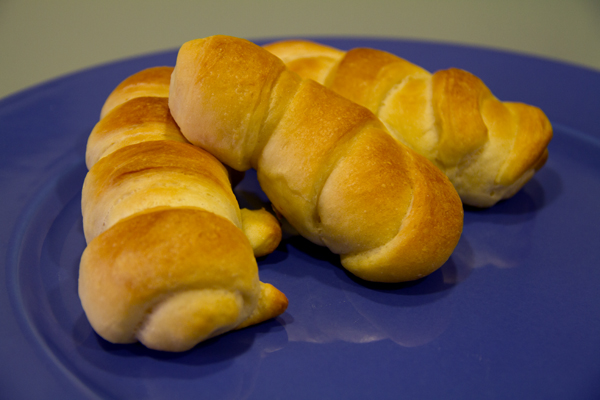
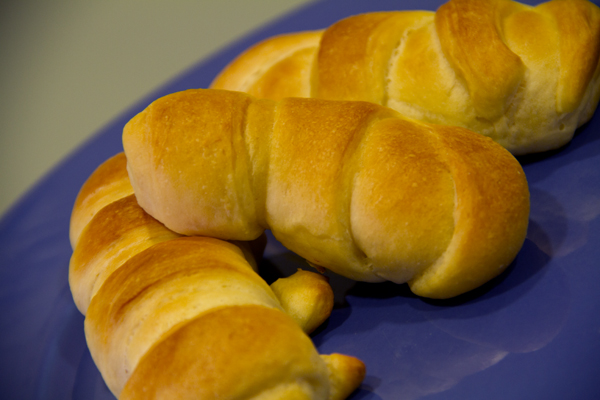
  • To do this, we have two methods. The first one is to take each piece of dough and roll it on itself, as if the bun were swallowing itself up. (Since my explanation leaves a lot to be desired, you can watch it in this video). The second method is to roll out each piece of dough into a rectangular shape. On one of the ends, make three or four cuts with a sharp knife to create some fringes. Finally, roll up the dough starting from the side opposite the fringes, so that when you finish, the fringes end up on the outside and give that distinctive look of milk buns.

  • Brush the buns with a little milk, let them rest on a baking tray lined with parchment paper for about 20 minutes, and meanwhile preheat the oven to 180°C (355°F).

  • Bake the buns for 10-12 minutes, and let them cool to room temperature on a wire rack.

Tips:

  • If you let the dough rest longer, nothing happens except that it might grow out of control (like what happened to us, when we discovered a mutant dough trying to escape from the bowl).
  • To shape the buns, we used the two methods we found at La Receta de la Felicidad, since we made two batches of dough and one of them (despite following the same steps) came out stickier, so the first method was easier for us.
  • The flavor in my opinion isn’t exactly the same as store-bought milk buns, but they are delicious, very fluffy, and you can fill them with both sweet and savory fillings.

Pics and Cakes

*[English version] MILK BREAD BUNS ** *Ingredients:

- 500 g strong bread flour - 25 g fresh yeast (or two sachets dry yeast) - 250 ml milk - 70 g butter, room temperature - 40 g sugar - 1 egg - 2 tbs honey - A pinch of salt

  • Combine flour and yeast in a bowl. Add the egg, honey, milk, sugar and salt and mix well.

  • Add butter and use a large spoon or fork to mix everything together.

  • Take the dough out of the bowl and knead. You will feel the dough become elastic after kneading for about 5 minutes. Knead the dough for 5-10 minutes more or until the dough is soft, pliable, smooth and slightly shiny-

  • Put the dough into a lightly floured bowl and cover with a cloth. Let the dough rise in a warm place until its size doubles (aprox. two hours)

  • Take the dough out of the bowl, deflate it by touching lightly.

  • Cut the dough into 16 pieces, and roll each of them into an oval shape. Or alternatively, roll out each piece of dough forming a rectangle 1 cm thick. Cut 1/3 the length of the rectangle into 4/5 strips of equal width and roll up the dough similar to a Swiss roll.

  • Preheat oven to 180ºC and let the milk buns rest for 20 minutes.

  • Glaze the buns with some milk, and bake them for 10-12 minutes. Let them cool on a wire rack

  • Tips:**- Nothing wrong if you leave the dough more time covered with a cloth, it will just rise even more! * - We made the bun shape following the two different methods. For sticky doughs is easier the first method (just forming the oval shape). *- You won’t achieve exactly the same flavor than the milk buns of the supermarket but it is absolutely delicious, spongy and can be filled with sweet or savory ingredients. *


Comments

marmota zampona (2012-09-12 08:16:25):

we’ll make them. thanks

8 de septiembre de 2012 · 4 min · Palstelera

Panes de leche

Estábamos preparando una merienda sorpresa en la que queríamos que todo fuese absolutamente casero, así que no podíamos permitirnos comprar ni siquiera el pan. Una de las cosas que queríamos hacer eran pequeños bocadillitos salados y, una vez más, recurrimos al blog de La Receta de la Felicidad para seguir sus pasos y hacer unos estupendos panes de leche. Lo cierto es que pensábamos que sería bastante complicado pero qué equivocados estábamos…

Pics and Cakes

¿Qué necesitamos?

(16 panecillos)

  •       500 g de harina de fuerza
  •       25 g de levadura fresca (o dos sobres de levadura seca de panadería)
  •       250 ml de leche
  •       70 g de mantequilla, en pomada (o sea, blandita)
  •       40 g de azúcar
  •       1 huevo
  •       2 cucharadas de miel
  •       1 pizca de sal

¿Cómo lo hacemos?

  • Mezclamos la harina con la levadura en un bol grande y añadimos el huevo y la leche.

  • Agregamos azúcar, miel y sal, mezclamos bien con la ayuda de una cuchara o tenedor.

  • Agregamos la mantequilla, y amasamos 10-15 minutos, hasta que obtengamos una masa suave, plegable, y ligeramente brillante

  • Formamos una bola con la masa, girándola y doblándola hacia el interior, y la dejamos reposar en un bol ligeramente enharinado, tapada con un paño, durante unas dos horas para que duplique su volumen.

  • Sacamos la masa del bol, y la aplastamos un poco con los dedos para ‘desinflarla’.

  • Cortamos la masa en 16 porciones, y les damos forma de panecillo.

  • Para ello, tenemos dos métodos. El primero consiste en coger cada porción de masa e ir enrollando la masa sobre sí misma como si el propio bollo se auto-engullese. (Como mi explicación deja mucho que desear podéis verlo en este vídeo). El segundo método consistiría en estirar cada porción de masa hasta tener una forma rectangular. En uno de los extremos, hacemos tres o cuatro cortes con un cuchillo afilado para crear unos flecos. Por último enrollamos la masa empezando por el lado contrario a los flecos para que al acabar sean éstos los que queden hacia afuera y den ese aspecto tan característico de los panes de leche.

  • Pincelamos los panecillos con un poco de leche, los dejamos reposar sobre una bandeja de horno forrada de papel de hornear unos 20 min, y mientras precalentamos el horno a 180 ºC.

  • Horneamos los panecillos entre 10-12 minutos, y dejamos enfriar a temperatura ambiente sobre una rejilla.

Consejos:

  • Si dejáis reposar más tiempo la masa, no pasa nada excepto que puede crecer desmesuradamente (como nos pasó a nosotros que descubrimos una masa mutante tratando de escaparse del cuenco).
  • Para formar los panecillos, seguimos los dos métodos que encontramos en La Receta de la Felicidad, ya que hicimos dos medidas de masa y una de ellas (pese a seguir los mismos pasos) nos quedó más pegajosa así que nos resultó más fácil el primer método.
  • El sabor conseguido en mi opinión no es exactamente igual que el de los panes de leche comprados pero es están deliciosos, son muy esponjosos y los podéis rellenar tanto de dulce como de salado.

Pics and Cakes

*[English version] MILK BREAD BUNS ** *Ingredients:

- 500 g strong bread flour - 25 g fresh yeast (or two sachets dry yeast) - 250 ml milk - 70 g butter, room temperature - 40 g sugar - 1 egg - 2 tbs honey - A pinch of salt

* *

  • Combine flour and yeast in a bowl. Add the egg, honey, milk, sugar and salt and mix well.

  • Add butter and use a large spoon or fork to mix everything together.

  • Take the dough out of the bowl and knead. You will feel the dough become elastic after kneading for about 5 minutes. Knead the dough for 5-10 minutes more or until the dough is soft, pliable, smooth and slightly shiny-

  • Put the dough into a lightly floured bowl and cover with a cloth. Let the dough rise in a warm place until its size doubles (aprox. two hours)

  • Take the dough out of the bowl, deflate it by touching lightly.

  • Cut the dough into 16 pieces, and roll each of them into an oval shape. Or alternatively, roll out each piece of dough forming a rectangle 1 cm thick. Cut 1/3 the length of the rectangle into 4/5 strips of equal width and roll up the dough similar to a Swiss roll.

  • Preheat oven to 180ºC and let the milk buns rest for 20 minutes.

  • Glaze the buns with some milk, and bake them for 10-12 minutes. Let them cool on a wire rack

* *

*  Tips:**- Nothing wrong if you leave the dough more time covered with a cloth, it will just rise even more! * - We made the bun shape following the two different methods. For sticky doughs is easier the first method (just forming the oval shape). *- You won’t achieve exactly the same flavor than the milk buns of the supermarket but it is absolutely delicious, spongy and can be filled with sweet or savory ingredients. *


8 de septiembre de 2012 · 4 min · Palstelera