Ciabatta Bread
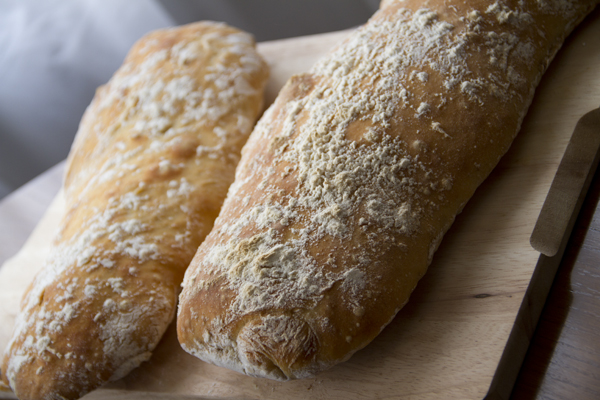
Whole Kitchen in their Savory Challenge for the month of November invites us to prepare an Italian classic: “Ciabatta”. I had been really wanting to make this recipe but I never thought it would turn out well, and… it turned out so well, yes indeed! It even looked like a real ciabatta. The recipe is slow because of the rising times, but it’s simple to make and the result is incredibly good.
What do we need?
(For two loaves)
For the starter:
2.5 g fresh yeast
150 ml (2/3 cup) water
3 tablespoons warm milk
1/4 teaspoon honey or granulated sugar
150 g (1.25 cups) bread flour
For the dough:
2.5 g fresh yeast
250 ml (1 cup) water
1/2 tablespoon olive oil
350 g (2.75 cups) bread flour
1 and 1/2 teaspoons salt
How do we make it?
First, we prepare the starter. Sprinkle the yeast into a large bowl with the water and milk. Let it sit for 5 minutes, then add the honey or sugar and stir to dissolve.
Add the flour and mix to form a loose dough. Cover the bowl with a kitchen towel and let it ferment for 12 hours or overnight.
Once the wait is over, we move on to the dough. Sprinkle the yeast into a small bowl with the water. Let it sit for 5 minutes; stir to dissolve. Add the yeast water and the olive oil to the starter and mix well.
Into the bowl, add the flour with the salt and mix to form a wet, sticky dough. Beat continuously with a wooden spoon for 5 minutes; the dough will turn fluffy and start to pull away from the sides, but it will still be too soft to knead.
Cover the dough with a kitchen towel. Let it ferment for about 3 hours, until the dough has tripled in size and is full of air bubbles. Generously flour two baking sheets and have extra flour ready to dust your hands.
Divide the dough in half while it’s still in the bowl. Tip half of the dough onto one of the sheets.
With your hands well coated in flour, shape it into a rectangular loaf about 30 cm (12 inches) long. Dust the loaf and your hands again with flour. Tidy and thicken it by running your fingers along the sides and gently tucking under the bottom of the dough. Repeat the same with the other half.
Uncovered, let the loaves rise for about 20 minutes; they will spread out and grow in volume.
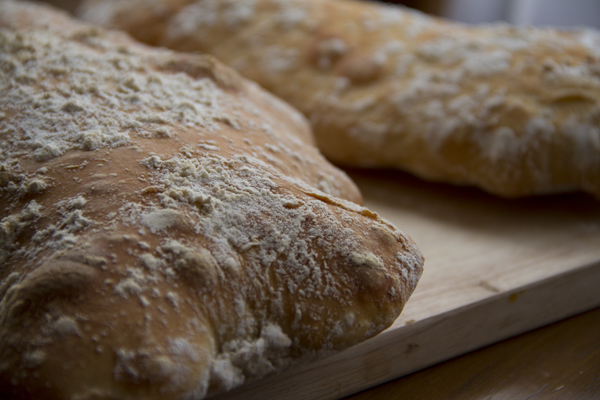
Put them in the oven, preheated to 220°C (430°F), and bake for 30 minutes until the loaves have risen, are golden brown, and sound hollow when tapped on the bottom. Let cool on a wire rack.
Tips:
It’s a very sticky dough that you barely have to work with your hands. That’s why, in the final steps, it’s important to keep your hands well covered in flour and not handle the dough too much, since otherwise half of it will end up stuck to you.
I use the pressed baker’s yeast you can find in cubes in the supermarket in the bakery/pastry section, always refrigerated. I buy a bunch and freeze them, so I always have some on hand whenever I need it. That said, it’s important to keep in mind that frozen yeast loses a bit of its “power”, so you’ll need to add a little more than what the recipe calls for.
When baking, I put both sheets in at the same time and after 20 minutes I swapped them so that both loaves cooked evenly on both sides.
Comments
Marisa (2012-11-22 12:51:05):
She brought a piece home for me and it’s awesome, delicious, amazing… mmm, I want more!
tía pi (2012-11-22 18:13:13):
It’s a pleasure how well you explain everything and the tips you give. I promise to make it and tell you how it turns out.
Angeles (2012-11-22 22:35:32):
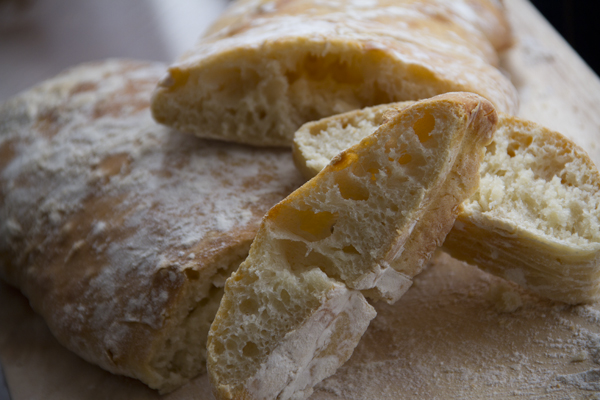
It looks fantastic, just like an authentic Italian ciabatta.
marmota zampona (2012-11-24 19:27:46):
I’m going to give it a try right now.